



International cricket is one of the world’s most established and widely followed sports. Played across several formats and continents, cricket brings together national teams with different playing styles, tactical approaches, and sporting traditions. From historic Test matches to fast-paced Twenty20 competitions, international cricket provides a diverse calendar of matches for fans around the world.
Understanding cricket teams, formats, rankings, major tournaments, and key match factors can help both new and experienced followers appreciate the sport more deeply.
Understanding International Cricket
International cricket is played between national teams representing their respective countries. Matches can range from multi-day Test matches to shorter One Day Internationals and Twenty20 internationals.
Each format requires a different tactical approach. Test cricket emphasizes patience, endurance, technique, and long-term strategy. One Day Internationals combine traditional batting and bowling skills with a fixed number of overs. Twenty20 cricket is considerably faster, with teams having limited opportunities to score runs and take wickets.
The variety of formats is one of cricket’s greatest strengths. Fans can choose between traditional long-form competition and short, high-intensity matches.
Major International Cricket Teams
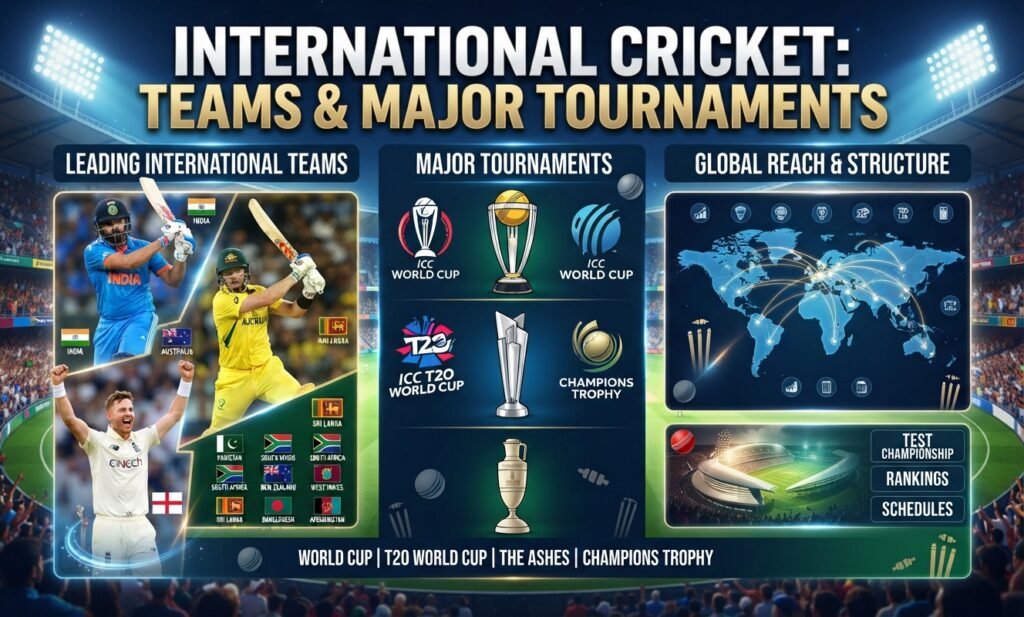
Several national teams have established strong traditions in international cricket. India, Australia, England, Pakistan, South Africa, New Zealand, Sri Lanka, Bangladesh, and the West Indies have all made significant contributions to the international game.
India has a particularly large cricket following, while Australia has a long history of success across multiple formats. England is closely associated with the development of organized cricket and hosts major international competitions.
Pakistan is known for producing talented fast bowlers and dynamic batsmen. New Zealand has consistently competed at the highest international level, while South Africa has developed many technically accomplished players.
Sri Lanka has produced several outstanding cricketers and remains an important force in international competition. Bangladesh has also developed significantly over recent decades, particularly in limited-overs cricket.
Test Cricket
Test cricket is the longest international format and can last up to five days. Each team generally has two innings, although a match can finish earlier depending on the result.
Test cricket places significant emphasis on technique and concentration. Batters must manage different bowling conditions over long periods, while bowlers need to maintain accuracy and develop strategies for dismissing opponents.
Weather, pitch conditions, player fitness, and tactical declarations can all influence a Test match. A team may dominate one session and face significant pressure later in the game.
Major Test series, including the Ashes between England and Australia, have a long history and remain highly significant within international cricket.
One Day International Cricket
One Day Internationals, commonly known as ODIs, provide a balance between traditional cricket and shorter formats. Each team receives a fixed number of overs, creating a defined time limit for the competition.
ODI strategy changes as an innings progresses. Teams may begin cautiously before increasing their scoring rate during the middle and final overs. Bowlers must manage limited overs carefully, while fielding strategies can change depending on the batting situation.
The ICC Cricket World Cup is one of the most important ODI competitions, bringing together leading national teams in a global tournament.
Twenty20 International Cricket
Twenty20 internationals, or T20Is, are among the fastest forms of international cricket. Each team generally receives 20 overs, meaning every delivery can have a significant impact.
T20 cricket encourages aggressive batting, creative bowling, athletic fielding, and rapid tactical decisions. Players often specialize in particular skills, such as power hitting, death-over bowling, or specialist fielding.
The ICC Men’s and Women’s T20 World Cups provide major international stages for teams competing in this format.
Major Cricket Tournaments
International cricket includes several major tournaments. The ICC Cricket World Cup is one of the sport’s premier events, featuring national teams competing for the global ODI championship.
The ICC T20 World Cup focuses on the shortest international format and has become a major event on the global cricket calendar.
The ICC Champions Trophy is another important limited-overs competition featuring leading international teams.
Women’s international cricket also has major global tournaments, including the ICC Women’s Cricket World Cup and ICC Women’s T20 World Cup.
These competitions provide opportunities for established teams and emerging cricket nations to compete on the same international stage.
Cricket Rankings and Team Performance
International rankings provide a way to compare teams based on their recent performances. Rankings are maintained separately for different formats, including Tests, ODIs, and T20Is.
A team’s ranking can change as it wins or loses matches and series. However, rankings should be considered alongside recent form, opposition quality, home and away conditions, and the format being played.
A team that performs strongly in Test cricket may have a different level of success in T20 cricket because each format requires different skills and tactical approaches.
Key Player Roles
Successful cricket teams depend on players fulfilling specialized roles. Opening batters typically face the new ball and aim to establish a strong foundation. Middle-order batters may be responsible for building an innings or accelerating scoring.
Fast bowlers can generate pace, bounce, and movement, while spin bowlers often become particularly important on surfaces that offer turn.
All-rounders contribute with both bat and ball, providing teams with additional tactical flexibility. Wicketkeepers combine specialist catching and stumping skills with batting responsibilities.
Factors That Influence Cricket Matches
Several conditions can affect an international cricket match. The pitch is particularly important because its characteristics can influence batting and bowling.
Weather can also play a major role. Cloud cover and humidity may assist swing bowling, while hot and dry conditions can favor spin in certain environments.
Toss decisions can influence tactics because captains must determine whether to bat or bowl first. In limited-overs cricket, teams may also consider dew, pitch conditions, and expected scoring patterns.
Player availability is another important consideration. Injuries, workload management, and squad selection can influence team combinations.
Following an International Cricket Tournament
Fans can follow a tournament using a variety of information, including:
- Match schedules
- Team rankings
- Tournament groups
- Points tables
- Recent results
- Player statistics
- Batting averages
- Bowling figures
- Net run rate
- Tournament brackets
Understanding the tournament format is especially useful. Some competitions use group stages followed by semifinals and finals, while others may feature league-based structures or qualification rounds.
Technology in Modern Cricket
Technology has become an important part of modern cricket. Systems such as ball-tracking technology and video review help officials make difficult decisions.
Broadcast technology also provides detailed statistics, wagon wheels, pitch maps, player tracking, and other information that helps viewers understand match developments.
Teams use performance data to study opponents and evaluate their own players. Analysts can examine batting patterns, bowling locations, scoring areas, and fielding performance to develop tactical plans.
Cricket and Online Sports Information
The growth of digital sports coverage has made international cricket information more accessible. Fans can follow live scores, fixtures, player updates, rankings, and tournament news through official sports platforms and reputable media outlets.
People searching for cricket-related services may also encounter phrases such as online betting agent list. Anyone considering betting-related services should independently verify applicable local laws, age restrictions, platform terms, and responsible-use information before participating.
The Future of International Cricket
International cricket continues to evolve as governing bodies introduce new competitions, scheduling structures, and playing conditions. The growth of women’s cricket has also expanded the sport’s global reach, while shorter formats have attracted new audiences.
At the same time, Test cricket continues to maintain an important place in the international game. The coexistence of multiple formats gives players and fans different ways to experience cricket.
Emerging cricket nations are also gaining greater exposure through international tournaments and qualification competitions. This expansion can contribute to a broader and more diverse cricketing community.
Conclusion
International cricket combines history, strategy, athletic ability, and national sporting identity. From Test series and ODI competitions to fast-paced T20 internationals, every format offers distinctive challenges.
Major tournaments such as the Cricket World Cup, T20 World Cup, Champions Trophy, and women’s global competitions provide important stages for national teams and players. By following rankings, statistics, schedules, conditions, and tournament structures, fans can gain a deeper understanding of international cricket.
Whether following a traditional Test series or an exciting limited-overs tournament, international cricket continues to provide competitive matches and memorable sporting moments for audiences around the world.