


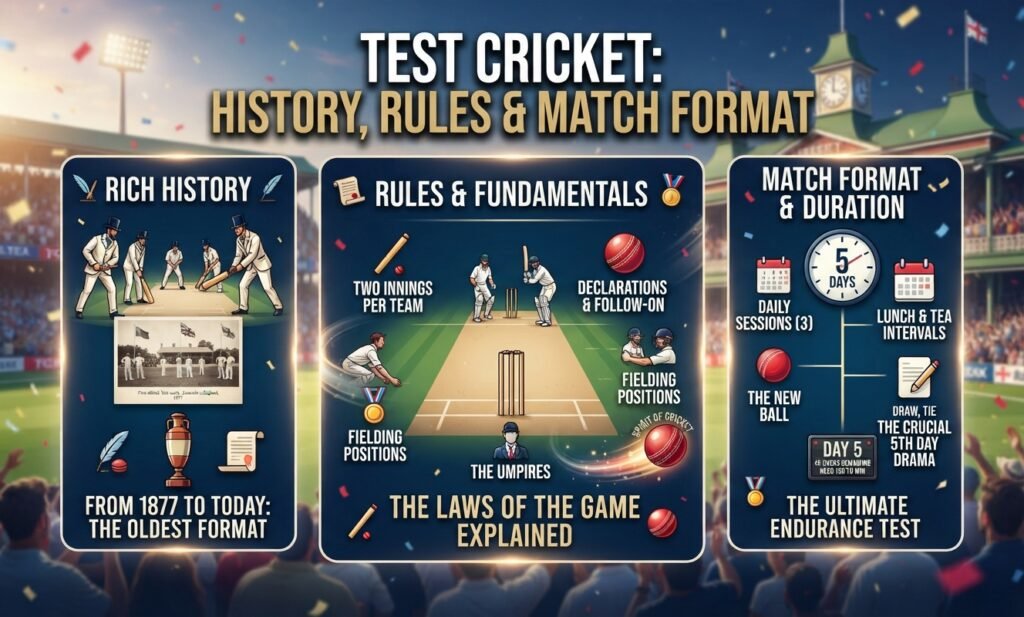

Test cricket is the longest and one of the most traditional forms of international cricket. Known for its demanding match format, strategic depth, and emphasis on patience, Test cricket challenges players across multiple days. Unlike shorter formats such as One Day Internationals and T20 cricket, Test matches allow teams more time to build innings, create bowling strategies, and adapt to changing pitch and weather conditions.
With a history spanning more than a century, Test cricket has become an important part of international sport. Its famous rivalries, historic venues, legendary players, and dramatic finishes continue to attract cricket fans around the world.
What Is Test Cricket?
Test cricket is an international format in which two national teams compete over a maximum of five days. Each team normally has two innings, meaning both batting and bowling sides have opportunities to establish an advantage.
A Test match can end in several ways, including a win, loss, draw, or tie. A draw occurs when the scheduled time expires without one team achieving victory, while a tie is extremely rare and happens when both teams finish with exactly the same score after completing their innings.
The extended format makes Test cricket different from limited-overs cricket. Players must manage their physical energy, concentration, and tactical decisions over several days.
History of Test Cricket
The history of Test cricket can be traced to the late nineteenth century. England and Australia played the first officially recognized Test match in Melbourne in 1877. This match established the foundation for international red-ball cricket.
Over time, more nations gained Test status and joined the international cricket community. Countries such as South Africa, West Indies, New Zealand, India, Pakistan, Sri Lanka, Bangladesh, Zimbabwe, Afghanistan, and Ireland have subsequently become part of Test cricket’s international landscape.
The format has evolved significantly. Early Test matches were played without many of the modern facilities and technologies available today. Advances in protective equipment, pitch preparation, player fitness, broadcasting, and decision-review systems have transformed the experience while preserving the basic principles of the game.
Test Match Format
A standard Test match can last up to five days, although matches may finish earlier if a team wins or other circumstances prevent the completion of play.
Each team has the opportunity to bat twice. The basic structure is:
- Team A bats.
- Team B bats.
- Team A bats again.
- Team B bats again.
However, the order can change depending on the match situation. A captain may choose to enforce the follow-on when specific conditions are met, requiring the opposing team to bat again immediately after its first innings.
A team wins by scoring more runs than its opponent while taking all necessary wickets in the final innings, or by achieving the required result under the laws of cricket.
How Batting Works
Test batting requires concentration, technique, and adaptability. A batter’s objective is to score runs while protecting their wicket from the bowling attack.
There are no restrictions on the number of overs a team can face during an innings. This allows batters to play defensively when conditions are difficult or attack when opportunities arise.
Batters can score through boundaries, running between the wickets, and various shot selections. However, survival is often just as important as scoring quickly. A batter may spend several hours at the crease building an innings.
The Role of Bowling
Bowling is central to Test cricket strategy. Fast bowlers can exploit movement through the air and off the pitch, while spin bowlers can become increasingly influential as the playing surface changes.
Bowlers work in partnerships and attempt to create pressure through accurate lines, changing speeds, variations, and field placements. Captains may rotate bowlers according to pitch conditions, batter weaknesses, workload, and match circumstances.
Unlike limited-overs cricket, bowlers can repeatedly attack a batter over long periods. This creates tactical battles that can develop throughout an entire session or even across multiple days.
Fielding and Dismissals
Fielding plays a major role in Test cricket because a single mistake can change the direction of a match. Fielders must maintain concentration for long periods and react quickly when opportunities arise.
Common methods of dismissal include bowled, caught, leg before wicket, run out, stumped, hit wicket, and several other forms recognized under the Laws of Cricket.
Slip fielders are particularly important when fast bowlers are generating movement, while close-in fielders may support spin bowlers by standing near the bat.
The Importance of Pitch and Conditions
One of the defining characteristics of Test cricket is the influence of playing conditions. Pitch behavior can change throughout a match, creating different challenges for batters and bowlers.
A fresh pitch may offer assistance to fast bowlers, while a surface can become more favorable for spin as the match progresses. Weather also affects conditions. Cloud cover, humidity, wind, and temperature can influence swing, seam movement, and batting conditions.
Teams therefore need to adapt continuously rather than relying on one fixed strategy.
Sessions and Daily Play
A traditional Test day is divided into three main sessions, with scheduled intervals for lunch and tea. There is also a break between innings when appropriate.
The session structure helps players manage the physical demands of long-form cricket. Teams often set short-term objectives for each session, such as surviving a difficult period with the bat, taking early wickets, or controlling the scoring rate.
This creates a layered strategic battle in which every session contributes to the larger match situation.
Draws and Tactical Patience
The possibility of a draw is one of the features that separates Test cricket from most limited-overs formats. A team may focus on survival rather than victory if the match situation makes a positive result difficult.
Batters can spend long periods defending, while captains may set highly defensive fields to prevent scoring opportunities. Such situations demonstrate why Test cricket requires patience and strategic discipline.
At the same time, teams can accelerate their scoring to create enough time to dismiss the opposition. Declarations allow a captain to voluntarily end an innings and give the bowling side more time to take wickets.
Major Test Cricket Competitions
Test cricket includes historic bilateral series and major international competitions. Some of the most recognized rivalries have developed through repeated Test series between nations.
The Ashes between England and Australia is one of the most famous Test cricket contests. India and Australia, India and England, Pakistan and India, South Africa and Australia, and several other matchups have also produced memorable Test cricket moments.
The ICC World Test Championship has added another major dimension by providing a championship structure across a cycle of Test series. It gives teams an opportunity to compete for a global title based on their performances over an extended period.
Test Cricket Records and Milestones
Test cricket has produced numerous remarkable individual and team records. These include huge innings totals, large numbers of wickets, centuries, double centuries, five-wicket hauls, and long careers.
Some players have represented their countries for decades, while others have made immediate impacts through outstanding performances. Milestones such as 100 Test appearances, 10,000 Test runs, or hundreds of wickets are considered significant achievements.
Records also highlight the importance of consistency. A successful Test career generally requires maintaining performance across different countries, pitches, opponents, and conditions.
Test Cricket in the Modern Era
Technology has changed the way Test cricket is played and watched. Ball-tracking systems, television replays, decision-review technology, advanced statistics, and improved broadcasting provide additional information to players and spectators.
Despite these changes, the fundamentals remain largely unchanged. Teams still need technically skilled batters, disciplined bowlers, reliable fielders, and tactically capable leadership.
For readers researching cricket-related commercial information, an online betting agent list may appear alongside sports content, but official cricket organizations and tournament authorities remain the appropriate sources for rules, schedules, scorecards, and verified match information.
Conclusion
Test cricket combines history, technique, strategy, endurance, and tradition. Its five-day format gives teams opportunities to recover from difficult periods, change tactics, and build pressure gradually.
From its origins in nineteenth-century England and Australia to the modern World Test Championship era, Test cricket has remained an important part of international sport. Its unique format allows individual brilliance and team strategy to develop over several days, creating some of cricket’s most memorable contests.
For anyone interested in understanding cricket at its deepest strategic level, learning the history, rules, match format, and traditions of Test cricket provides an excellent foundation.