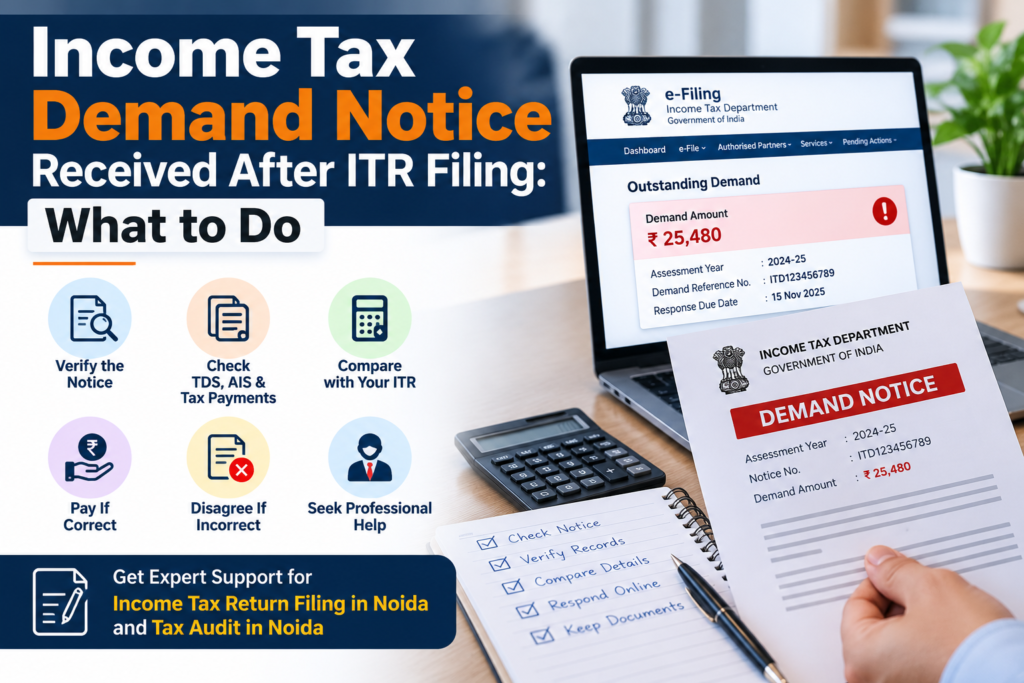

Receiving an income tax demand notice after filing your Income Tax Return (ITR) can be confusing. You may have already paid your taxes and submitted your return, yet the Income Tax Department may show an additional amount payable. This can happen because of differences in tax calculations, missing tax credits, incorrect deductions, or other discrepancies identified during processing.
An income tax demand notice does not always mean that you have made a mistake. The important step is to understand why the demand was raised and respond through the appropriate procedure within the specified time.
If you need assistance with Income Tax Return Filing in Noida, understanding how to verify and respond to a demand can help you manage your tax compliance more confidently.
Quick Summary
- Verify the demand notice on the official Income Tax e-Filing portal.
- Compare the demand with your filed ITR and tax computation.
- Check Form 26AS, AIS, TDS certificates, and tax payment challans.
- Agree with the demand if it is correct and pay the amount due.
- If the demand is incorrect, submit an appropriate disagreement response or consider rectification where applicable.
- Keep supporting documents and acknowledgement numbers for your records.
1. Why Do You Receive an Income Tax Demand Notice?
The Income Tax Department may raise a demand after processing your return or completing an assessment. Common reasons include:
TDS credit mismatch: Tax deducted by your employer, bank, or client may not match the information reported against your PAN.
Incorrect tax calculation: The tax calculated in your return may differ from the department’s calculation.
Missing tax payment: An advance tax or self-assessment tax payment may not have been correctly reflected in the records.
Incorrect deductions or exemptions: A deduction or exemption claimed in the return may have been disallowed or adjusted.
Interest or late filing fee: Applicable interest or fees may increase the amount payable.
Earlier outstanding demand: A previous year’s unpaid demand may continue to appear against your PAN.
Identifying the reason is essential before deciding whether to pay or dispute the demand.
2. Step One: Verify the Demand Notice
Visit the official Income Tax e-Filing portal:
Log in and navigate to Pending Actions → Response to Outstanding Demand.
Review the demand details and, where available, download the relevant intimation or order. Check the assessment year, demand amount, reference number, and reason for the demand.
Do not rely solely on an email or SMS. Verify the communication through your official account and follow the instructions mentioned in the notice.
The Income Tax Department provides an online facility to review outstanding demands and submit responses.
3. Step Two: Compare the Demand with Your ITR
Before responding, compare the demand with your original return and supporting records.
Review the following:
- Filed ITR and income tax computation
- Form 26AS and Annual Information Statement (AIS)
- Form 16 or Form 16A, where applicable
- Advance tax and self-assessment tax challans
- Bank statements and interest income
- Deduction and exemption documents
- Previous tax demand payments, if any
For example, suppose you paid ₹40,000 as self-assessment tax, but the department’s records do not reflect the payment. Locate the challan and verify the payment details. If the payment was successful, you may need to submit the relevant evidence through the prescribed response or correction procedure.
4. Step Three: Decide Whether to Agree or Disagree
After checking the records, determine whether the demand is correct.
If the Demand Is Correct
If you confirm that the amount is payable and has not already been paid, use the Pay Now option available on the portal, where applicable.
Complete the payment and save the challan and transaction details for future reference.
If You Have Already Paid the Demand
If the demand is correct but the payment has not been reflected, select the relevant option indicating that the amount has already been paid. Enter the requested challan details and upload proof of payment, following the portal’s instructions.
If the Demand Is Incorrect
If the demand is wrong, select the appropriate option to disagree with it, either fully or partially. Choose the relevant reason and provide the requested details and supporting evidence.
Important: The portal warns that confirming a demand as correct may prevent you from subsequently disputing it through the same response facility. Review your records carefully before submitting your response.
5. When Should You File a Rectification Request?
A rectification request may be appropriate when the demand results from a mistake apparent from the record in an eligible processed return or order.
For example, a discrepancy involving tax credit, a payment already made, or an apparent processing error may require further correction through the prescribed procedure.
However, rectification is not a universal solution for every demand. The correct remedy depends on the nature of the error, the order received, the applicable law, and the available statutory procedures.
Check the relevant intimation and the Income Tax Department’s current instructions before filing a rectification request.
6. What Happens If You Ignore an Income Tax Demand?
Ignoring an outstanding demand can create further complications. Depending on the circumstances, the demand may remain payable against your PAN or be adjusted against a refund, subject to applicable procedures and safeguards.
If the demand is incorrect, leaving it unanswered may delay its resolution. If it is correct, delaying payment may result in additional consequences under the applicable law.
Always check the response deadline stated in the communication and act accordingly.
7. How Tax Audit and Accurate Records Help
For businesses and professionals, maintaining proper financial records can help reduce discrepancies during tax return processing.
Businesses that require Tax Audit in Noida should ensure that their books of accounts, tax computations, TDS records, and supporting documents are consistent. Proper reconciliation helps identify differences before filing returns and makes it easier to respond if the department raises a query.
A tax audit does not guarantee that no demand will arise, but accurate records can help taxpayers explain their tax position more effectively.
8. How TaxCaller Can Help
TaxCaller provides tax consultancy, income tax return filing, accounting, and compliance assistance to individuals, professionals, and businesses.
If you need help with Income Tax Return Filing in Noida, our team can help you understand the return-processing details, review supporting records, and identify the appropriate response procedure.
TaxCaller also assists businesses with Tax Audit in Noida, tax planning, GST compliance, and related financial documentation.
Frequently Asked Questions
1. Does an income tax demand notice mean my ITR was incorrect?
Not necessarily. A demand may arise from a processing adjustment, missing payment record, tax credit mismatch, or another issue.
2. Can I dispute an incorrect income tax demand online?
Yes. The e-Filing portal provides a facility to submit a disagreement response for an outstanding demand. The appropriate procedure depends on the circumstances.
3. What if I already paid the tax demanded?
Submit the relevant response through the portal and provide the requested challan details and supporting payment evidence.
4. Can a tax consultant help with a demand notice?
A tax professional can help review the demand, reconcile tax records, and identify the appropriate response or correction procedure.
Conclusion
An income tax demand notice received after filing your ITR should be reviewed carefully rather than ignored. Verify the demand, compare it with your tax records, and decide whether to pay, report an earlier payment, dispute the demand, or seek rectification.
For assistance with Income Tax Return Filing in Noida or Tax Audit in Noida, TaxCaller can help you understand the applicable procedures and organise the relevant documentation.