


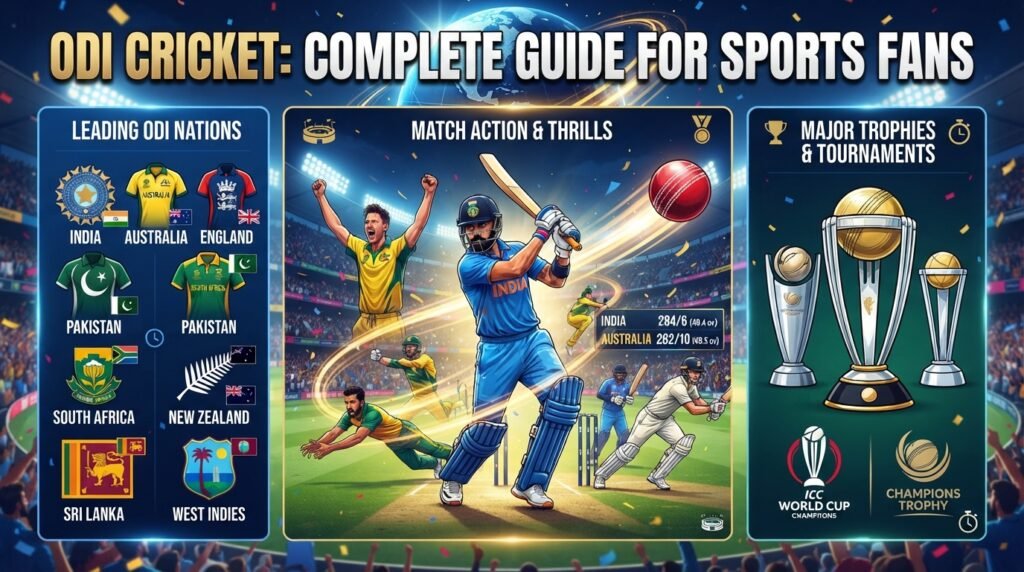

One Day International cricket, commonly known as ODI cricket, is one of the most established formats in international cricket. Combining the strategic depth of longer matches with the faster pace of limited-overs cricket, ODIs have produced some of the most memorable moments in the history of the sport. For new and experienced sports fans, understanding ODI cricket means learning about its rules, match structure, teams, tournaments, strategies, and key moments.
With international teams competing across bilateral series and major tournaments, ODI cricket remains an important part of the global cricket calendar.
What Is ODI Cricket?
An ODI is a limited-overs international cricket match in which each team normally receives up to 50 overs to bat. Unlike Test cricket, an ODI is completed within a single day, although weather interruptions or other circumstances can extend the match into additional scheduled time.
The format is designed to balance batting, bowling, and fielding. Teams must manage their resources carefully because they have a fixed number of deliveries available to score runs.
An ODI usually consists of two innings. The team batting first attempts to establish a competitive total, while the second team tries to chase that target within its allotted overs.
How an ODI Match Works
A standard ODI begins with a toss between the two captains. The captain winning the toss decides whether to bat or field first.
The first innings can last up to 50 overs, depending on wickets and other match conditions. Once the first team completes its innings, the second team begins its chase.
If the chasing team reaches the target before its 50 overs are completed, it wins. If it fails to reach the target, the team with the higher score wins.
Rain can significantly affect an ODI. When the scheduled number of overs is reduced, competition rules provide methods for calculating revised targets. The Duckworth-Lewis-Stern method is commonly used in rain-affected limited-overs matches.
ODI Teams and International Cricket
ODI cricket involves national teams from different cricket-playing countries. Teams such as India, Australia, England, Pakistan, New Zealand, South Africa, Sri Lanka, Bangladesh, and the West Indies have played major roles in international ODI history.
Other nations have also contributed to the development of the format. Afghanistan and Ireland, among others, have expanded the international competitive landscape and provided new cricketing audiences with opportunities to follow ODI competition.
The strength of teams can vary across periods because of player generations, domestic development systems, coaching structures, and emerging talent.
Major ODI Tournaments
The ICC Cricket World Cup is the most prominent ODI tournament. It brings together leading international teams and has produced many historic matches.
The World Cup has featured legendary performances from batsmen, bowlers, wicketkeepers, and all-rounders. Matches in the tournament often attract global audiences because every game can influence qualification and progression through the competition.
In addition to the World Cup, teams compete in bilateral ODI series and multi-team competitions. Regional cricket events can also provide important international ODI opportunities.
Batting in ODI Cricket
Successful ODI batting requires a combination of technique, timing, running between wickets, and strategic awareness.
An ODI innings can generally be divided into different phases. The opening overs may allow attacking stroke play, while the middle overs often require batsmen to rotate the strike and build partnerships.
The final overs are commonly associated with increased scoring rates. Batters may take greater risks by attempting boundaries and aggressive shots.
A strong ODI batting lineup usually includes different types of players. Opening batsmen may focus on establishing a platform, middle-order players may control the innings, and finishers can accelerate the score toward the end.
Bowling Strategies in ODIs
Bowling is equally important in determining an ODI result. Teams normally use a combination of fast bowlers and spin bowlers depending on conditions and opposition.
Fast bowlers can create pressure with pace, movement, bounce, and variations. Spin bowlers may become particularly influential when the pitch offers assistance with turn or when batters struggle to score freely.
Bowling plans also change throughout the innings. New-ball bowlers may attack early wickets, while middle-over bowlers often concentrate on controlling scoring and creating opportunities. Death-over specialists must defend runs against aggressive batsmen during the closing stages.
Fielding and Wicketkeeping
Fielding can have a major impact on an ODI match. A dropped catch, direct hit, or outstanding boundary save can change momentum.
Teams organize field placements according to the bowler, batter, match situation, and number of overs remaining. Captains must understand both attacking and defensive options.
Wicketkeepers also play an important role. They collect deliveries behind the stumps, contribute to dismissals, communicate with bowlers, and frequently help captains identify tactical opportunities.
Understanding ODI Statistics
ODI cricket produces a wide range of statistics that help fans analyze performances.
Important batting statistics include runs, batting average, strike rate, centuries, half-centuries, boundaries, and highest scores. Bowling statistics include wickets, bowling average, economy rate, strike rate, and best figures.
Team statistics can also reveal patterns. Run rates, partnership totals, powerplay scoring, wickets lost, and successful run chases provide useful context when comparing performances.
Statistics are particularly valuable when analyzing players across different eras because they provide measurable information beyond individual highlights.
Famous ODI Moments
ODI cricket has produced countless memorable moments. World Cup finals, dramatic run chases, record-breaking innings, exceptional bowling spells, and last-over finishes have all contributed to the format’s popularity.
Historic World Cup matches have often featured remarkable changes in momentum. A team that appears to be in control can quickly lose wickets, while a successful partnership can transform a difficult chase.
Individual performances have also become part of cricket history. Players who score centuries under pressure or take multiple wickets during crucial stages can leave a lasting impression on fans.
ODI Cricket and Modern Technology
Technology has become an important part of modern ODI cricket. Television replays, ball-tracking systems, decision-review technology, and statistical analysis have changed how matches are officiated and studied.
The Decision Review System allows teams to challenge certain on-field decisions according to competition regulations. Ball-tracking and other technologies provide additional information for officials when reviewing dismissals.
Modern teams also use performance data to study opponents, evaluate player workloads, and develop match strategies.
Following ODI Cricket as a Sports Fan
Fans can follow ODI cricket through international schedules, scorecards, official team announcements, tournament websites, and sports media. Understanding the rules and tactical phases makes matches easier to appreciate.
Those interested in sports-related commercial information may encounter an online betting agent list while researching cricket services, but official cricket boards and tournament organizers remain the appropriate sources for rules, schedules, results, and competition information.
Following player statistics can also make ODI cricket more engaging. Fans can compare batting performances, bowling figures, team records, and results across different tournaments.
The Future of ODI Cricket
Although international cricket now includes multiple formats, ODI cricket continues to occupy an important position. Its 50-over structure gives players enough time to build an innings while maintaining a defined match duration.
The format also remains central to major international competitions. Young players who develop through domestic cricket can eventually become important figures for their national ODI teams.
As cricket continues to evolve, ODI matches may incorporate further technological improvements, tactical innovations, and new generations of international stars.
Conclusion
ODI cricket offers a unique combination of strategy, skill, competition, and entertainment. With 50 overs per side, teams must carefully balance aggression and consistency across batting, bowling, and fielding.
From major World Cup contests to bilateral series, ODI cricket has created a rich history filled with outstanding performances and unforgettable matches. By understanding its rules, strategies, statistics, and tournament structure, sports fans can gain a deeper appreciation for one of international cricket’s most important formats.