


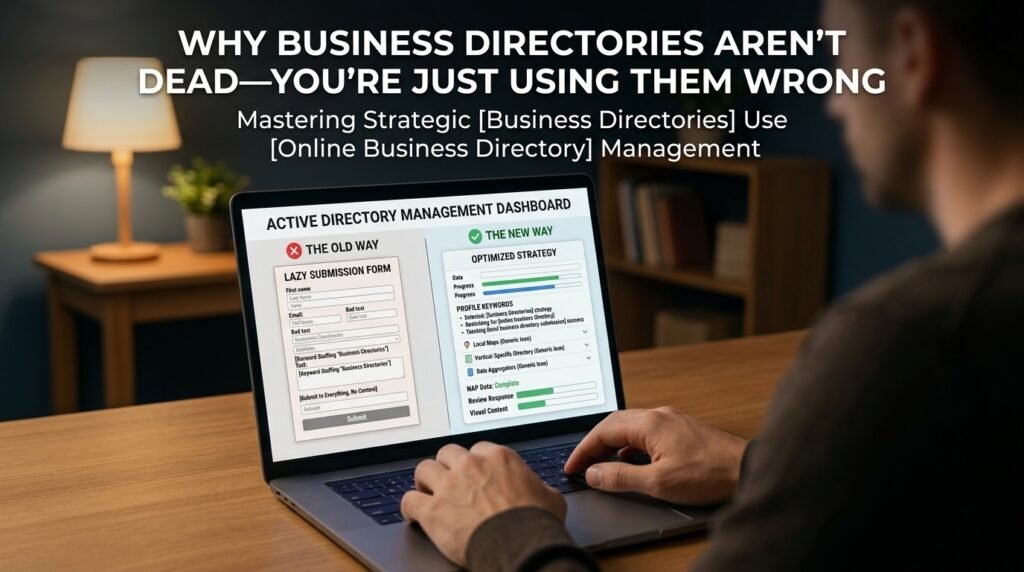

Every few years, someone will declare that business directories are dead. Google Business Profile devoured local search, the argument goes, so what’s the point?
The people making this argument are often the same people who bought a “500 directory submissions for $29” package in 2019, watched nothing happen. Concluded that the channel was dead. The channel wasn’t dead. The strategy was flawed.
Business directories do work in 2026 — just not as they used to. They no longer exist as an easy link-building tactic, but the directories now function as a discovery and trust layer that feeds directly into the systems that matter to customers: Google’s local pack, Apple Maps, voice search, AI-powered search results. The recommendation systems in the apps your customers use on a daily basis.
Let us talk about what that means for your business.
The Myth “Directories Are Dead” Came From a Real Problem
The myth has a history. It began in 2012 when Google’s Penguin algorithm began penalizing manipulative link building practices and thousands of “web directories” that existed solely to sell links were devalued. The myth is that directories are not a good place for a business to appear. That any citation is bad for the same reason that link farms are bad.
There is a big difference between a link farm masquerading as a directory, and a directory of businesses that are actively being searched for by real people. Google has repeatedly stated that citations are a good thing. In its Local 3-pack ranking factors article, Google states that relevance, proximity, and prominence are the three most important factors. Prominence is about how well known your business is. That is achieved through directory listings, articles about your business, and reviews.
So the question was never “do business directories work?” It was always “which ones, and how?”
What Business Directories Actually Do Now
If you’re evaluating directories purely on “will this boost my business ranking,” you’re measuring the wrong thing. Most directory links are nofollow anyway. Here’s the real value:
- They confirm you exist. Search engines verify and cross check your business name, address, and phone number (your NAP) across available sources. When that data matches everywhere, confidence goes up. When it doesn’t, Google hedges—and hedging looks like you ranking below the competitor whose details are clean.
- They send people directly. Any niche business listed on a well-trafficked directory gets calls from that directory. Not clicks that might eventually convert. Calls. Referral traffic from a well-chosen local business directory submission often converts better than paid search because the searcher already had intent when they arrived.
- They feed the machines. AI assistants and voice search pull structured business data from aggregated sources. If your hours, service area, and categories are wrong on those sources, you get left out of answers you’d otherwise win.
- They hold your reviews. Reviews on third-party directories show up in search results, influence purchase decisions, and give you a presence you don’t fully control—which, oddly, is exactly why people trust it.
The Mistakes That Make Directories Feel Useless
1. Playing the volume game
Listing on a hundred directories nobody visits is not a waste of time. Just a few strong listings,submitted correctly and consistently, will outperform hundreds of outdated ones. As everybody know Qualitybeats quantity every single time.
2. Letting your NAP drift
“Suite 200” on one site, “Ste. 200” on another, an old phone number on a third. This is the single most common reason directory work fails. Pick one exact format for your business name, address, and phone number, write it down, and use it everywhere without exception.
3. Filling in the bare minimum
Name, phone, done. That’s a wasted listing. Categories, service descriptions, business hours, payment methods, service areas, photos, and a link to a relevant landing page all affect whether your listing surfaces for a search. Directories with richer profiles reward businesses that actually use them—one reason platforms like Tekmag Listings have become a solid pick for US local businesses, since their profiles give you room to describe services properly instead of squeezing everything into one line.
4. Ignoring niche and regional options
General directories are table stakes. The leverage is in industry-specific ones. A contractor should be on home-services platforms. A lawyer should be on legal directories. A restaurant should be wherever local food searches happen.
5. Treating it as a one-time task
Businesses move. Phone numbers change. Holiday hours shift. Listings decay quietly, and a stale profile can actively cost you—nothing kills trust like a customer driving to an address you left two years ago. Audit quarterly.
6. Leaving duplicates in place
Duplicate listings split your reviews, confuse data aggregators, and dilute the signal you’re trying to send. Search your business name plus your city and see what’s out there. Claim what’s yours; request removal for the rest.
7. Not tracking anything
If you cannot identify which directories generate calls, you will be unable to make the right investment in them. Therefore, I suggest that you add UTM parameters to the link to the website for each directory listing. It will take only a few minutes. However, it will help you understand which directories are paying off.
How to Do Local Business Directory Submission Properly
Here’s a sequence that works, in order.
Start with the anchor. Claim and fully complete your Google Business Profile, Bing Places, and Apple Business Connect. These are the foundations that everything else supports.
Write your canonical NAP. One document. Exact legal business name, exact street address formatting, one primary phone number, one primary URL. This is your source of truth.
Build a short list. Aim for 15–25 directories: major general platforms, two or three industry-specific ones, and anything genuinely local—your chamber of commerce, city business associations, regional news directories. For US-based local businesses, this is where something like a curated promotional directory earns its place; Tekmag Listings sits in that middle ground of being broad enough to reach general searchers while still organizing businesses by city and category rather than dumping everyone into one list.
Complete every field. Unique description per platform where possible—copying identical text across twenty sites adds nothing.
Add photos. Storefront, team, work samples. Listings with images get more engagement, and engagement is a signal.
Tag your links. UTMs on everything.
Set a calendar reminder. Ninety days out. Check accuracy, respond to reviews, refresh photos.
How to Spot a Directory Worth Your Time
Before you submit anywhere, run this check:
- Does it have real traffic? Plug the domain into any free traffic estimator. If nobody visits, nobody will find you there.
- Is it moderated? Open a few listings. If you see obvious spam, gambling sites, or businesses that clearly don’t exist, walk away.
- Does it rank? Search “[your service] [your city]” and see which directories appear on page one. Those are the ones customers actually encounter.
- Is the data structured? Proper categories, filters, and location pages suggest the site is built for users, not for selling links.
- Can you claim and edit your listing? If you can’t control your own information, you have no way to keep it accurate.
Anything that fails two or more of these isn’t worth the fifteen minutes.
What Realistic Results Look Like
Set expectations properly. Directory work is slow, compounding, and unglamorous.
Weeks 1–4: listings go live, some referral traffic appears almost immediately from the higher-traffic platforms.
Months 2–3: citation consistency improves, and local pack visibility typically starts to firm up—especially if you were fixing bad data rather than starting from zero.
Months 4–6: reviews accumulate, niche directories start sending qualified leads, and you’ll have enough tracking data to double down on the three or four platforms doing real work.
Frequently Asked Questions
Are business directory links good for SEO? They are indirectly beneficial. Most of them use nofollow, meaning that from an SEO perspective they are not as valuable as editorial links. But they still provide a valuable source of citations, visibility and referral traffic.
How many directories are good for my business? There’s no magic number, but a reasonable range would be 15 to 25 directories. Any more than that and the ROI will plummet.
Should I pay for directory listings? Sometimes. Paid placement on a directory that ranks well for your service in your city can be worth it. Paying for bulk submissions to sites nobody visits never is.
What’s the biggest mistake with local business directory submission? Inconsistent NAP data. It undermines everything else you do.
The Bottom Line
Business directories are great for any company’s marketing strategy. They serve as a place for search engines, chatbots, and even potential clients to discover that your company exists and get basic information about it. The companies that do nothing with business directories are those that submitted their information somewhere years ago and haven’t been able to update their data correctly.
Select a few directories that are relevant to your business and its market. It could be a broad-based search engine or a more niche-specific directory like Tekmag Listings, suitable for businesses operating across the US. Update your information in these directories correctly and track which of them brought you clients.
Do that, and you’ll stop wondering whether directories still work—because you’ll be able to see exactly which ones do.