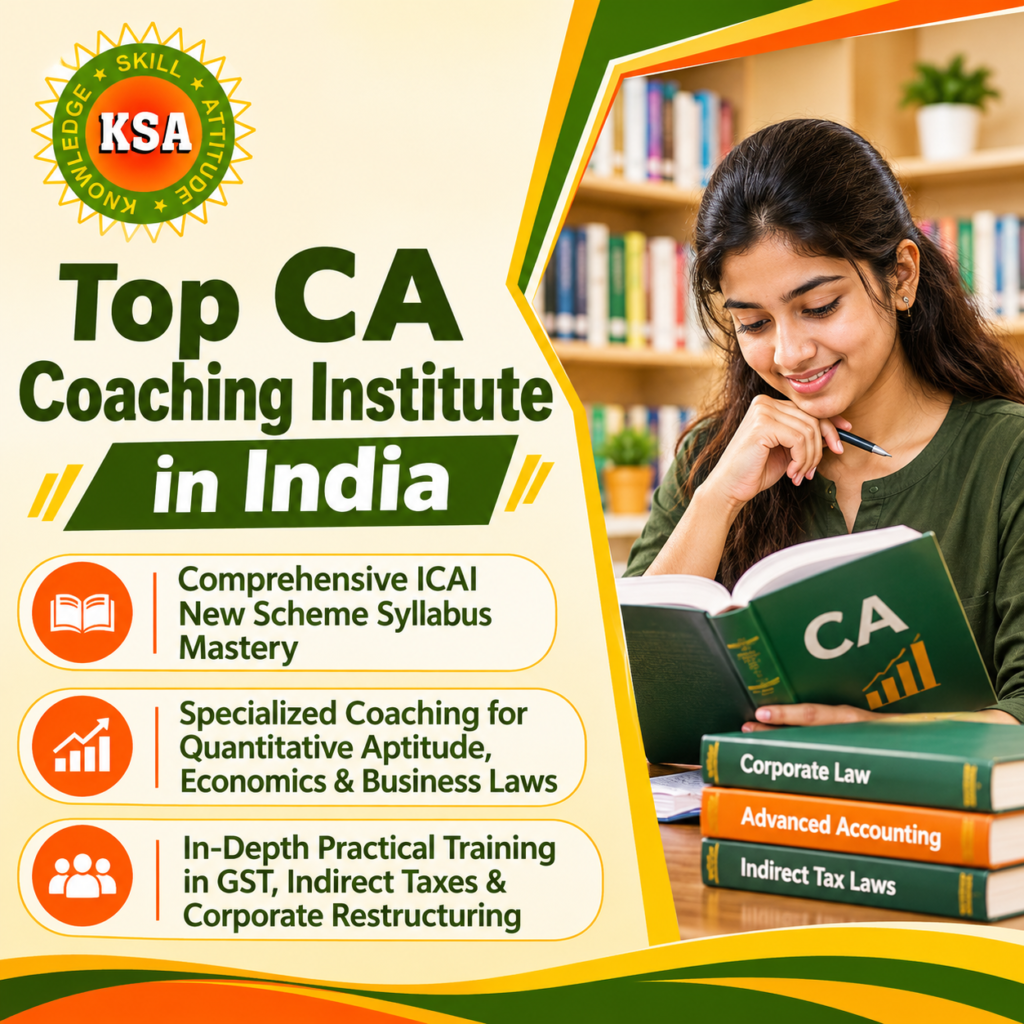

Passing the Chartered Accountancy examinations conducted by the Institute of Chartered Accountants of India (ICAI) rarely comes down to who spends the longest hours highlighting textbooks.
Instead, success across Foundation, Intermediate, and Final levels belongs to students who know how to read complex financial scenarios, apply changing tax rules accurately, and pace their writing over a demanding three-hour exam.
For aspirants in Tamil Nadu and across the country building a long-term study routine, looking at how structured academic systems work at Top CA coaching in India institutions—such as KS Academy in Chennai—offers practical guidance on preparing without burning out.
Adapting to Scenario-Driven Question Papers and Frequent Tax Updates
Over the last few years, ICAI question papers have shifted sharply away from predictable, memory-based questions toward practical commercial problem-solving.
In both Intermediate and Final examinations, 30 percent of the marks come from case-scenario multiple-choice questions, while 70 percent rely on detailed descriptive answers. Handling this mix well requires three specific study habits:
- Spotting Hidden Details in Case Studies: Reading long business scenarios carefully to catch subtle tax exemptions, audit risks, or accounting adjustments—especially in multi-subject papers like Integrated Business Solutions.
- Writing Clean Step-by-Step Working Notes: Even if a final balance sheet total slips by a small margin, ICAI evaluators award step marks whenever journal entries, working notes, and statutory section numbers are presented neatly.
- Tracking Legislative Changes Early: Direct tax clauses, GST circulars, and corporate law amendments change regularly, meaning outdated study materials can quietly cost valuable marks.
With Foundation and Intermediate exams taking place three times a year—in January, May/June, and September—and Final exams held every May and November, students have clear windows to plan their attempts.
Enrolling with a recognized Top CA Institute in India helps candidates follow a steady academic calendar that aligns syllabus coverage, Self-Paced Online Modules (SPOM), and the two-year practical articleship phase.
Inside the Classroom Methodology at KS Academy Chennai
Operating across well-connected educational hubs in Chennai—including West Mambalam (Aryagowda Road and Chakrapani Street Extension) and West Tambaram (VOC Street)—KS Academy organizes its classroom training around three practical principles: Knowledge, Skill, and Attitude (KSA).
Rather than turning lectures into fast-paced dictation sessions, instructors break down the everyday business reasoning behind accounting standards and legal provisions. When a student understands why a specific rule exists in corporate finance, applying it to an unfamiliar exam question becomes calm and intuitive.
Several practical features shape the daily learning experience:
- Guidance from Practicing Chartered Accountants: Classes are led by active professionals who connect textbook concepts directly to real statutory audits, corporate valuations, and tax compliance workflows.
- Bridge Sessions for Non-Commerce Students: Learners joining from science or humanities backgrounds receive dedicated introductory classes covering double-entry bookkeeping, journal entries, and core commercial terms before starting the main syllabus.
- Flexible Learning Formats: Students can attend face-to-face classroom batches, join live interactive online sessions, or revisit recorded portal lectures whenever a difficult topic needs a second review.
- Daily Doubt-Resolution Hours: Scheduled interaction windows outside regular lectures allow students to sit with faculty members and clear specific conceptual roadblocks before moving ahead.
For anyone evaluating options for the Best CA Coaching Centre in India, choosing an academic environment where complex topics are explained patiently and mentors remain accessible makes daily preparation far more manageable.
Turning Classroom Concepts into Exam-Hall Speed and Accuracy
Knowing the syllabus thoroughly only helps if a candidate can put accurate, well-structured answers on paper within 180 minutes. Many capable students lose marks simply because they spend too long on the opening questions and rush through the final section.
Regular practice tests—such as the Speed, Accuracy, and Presentation (SAP) exam series—help bridge the gap between classroom notes and real board exams. By writing weekly chapter tests, cumulative unit evaluations, and full-length mock papers under timed conditions, students learn to handle exam pressure well in advance.
Detailed answer-script reviews focus on three actionable improvements:
- Catching Small Calculation Errors: Identifying recurring arithmetic slips, missed adjustments, or incorrect statutory section references weeks before official exam dates.
- Structuring Answers for Easy Grading: Organizing audit checklists, tax computations, and legal opinions with clear headings so examiners can follow the logic effortlessly.
- Pacing Every Mark: Training students to budget roughly 1.8 minutes per mark across objective and descriptive sections so no part of the question paper is left incomplete.
Over time, steady testing turns exam-day anxiety into a familiar, controlled routine.
Calm Study Spaces Built for Deep Focus
Preparing for professional accountancy exams requires months of quiet reading, problem-solving, and revision, so having an organized study environment matters just as much as classroom lectures.
The Chennai campuses provide air-conditioned classrooms, modern visual teaching aids, and dedicated reading halls where students can revise without household distractions.
For outstation learners arriving from districts across Tamil Nadu and neighboring states, supervised hostel facilities with structured study hours and balanced meals help maintain a healthy, consistent daily schedule.
Conclusion: Moving Through the CA Journey One Milestone at a Time
Earning the Chartered Accountant credential opens doors to long-term leadership roles in statutory auditing, corporate finance, international taxation, and financial advisory.
While the path to qualification demands genuine patience and discipline, breaking the syllabus into clear weekly goals—supported by conceptual clarity, timely amendment tracking, and regular mock tests—keeps the goal realistic. With consistent daily effort and thoughtful mentorship, aspirants can walk into the ICAI examination hall prepared, composed, and ready to succeed.
visit now : https://ksacademy.co.in/
Mail : ksacademy23@gmail.com
Address : #44, Arya Gowda Road, West Mambalam, Chennai – 600033.
Other Locations:
KS Academy Bangalore : https://www.ksacademybangalore.in/
KS Academy Hyderabad : https://ksacademyhyderabad.in/
KS Academy Coimbatore: https://www.ksacademycoimbatore.com/
KS Academy Trichy : https://www.ksacademytrichy.com/