


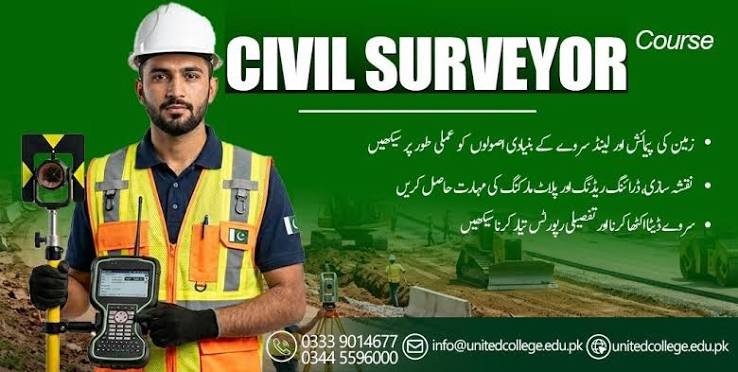

Construction projects are becoming more digital every year. From preparing site plans to measuring land and creating detailed project drawings, computers now play an important role in the daily work of a civil surveyor. Learning the right Civil Surveyor Skills can help beginners work more efficiently and understand modern construction technology.
A modern civil surveyor does more than take measurements on a construction site. They may work with surveying software, CAD programs, spreadsheets, digital maps, GPS data, and project documents. Because of this, computer knowledge has become an important part of professional surveying.
Why Computer Skills Matter for a Civil Surveyor?
Traditional surveying methods are still useful, but digital tools can make many tasks faster and more accurate. A surveyor may need to transfer field measurements into software, create drawings, calculate quantities, organize data, or share project information with engineers and contractors.
Strong Civil Surveyor Skills allow professionals to handle these tasks with greater confidence. Computer skills can also reduce repetitive work and make it easier to identify mistakes in measurements, drawings, and calculations.
For students starting a Civil Surveyor Course, learning basic computer applications alongside surveying concepts can provide a stronger foundation for future work.
Learn AutoCAD for Technical Drawings
AutoCAD is one of the most useful computer programs for people working in surveying and construction. Surveyors can use CAD software to prepare site plans, property layouts, road drawings, boundary plans, and other technical drawings.
A modern civil surveyor should understand basic drawing commands, layers, dimensions, annotations, coordinates, blocks, scaling, and file management. Understanding how to read and edit CAD drawings can make communication with engineers and other construction professionals easier.
Developing Civil Surveyor Skills through practical CAD exercises can also help students become more comfortable with real project drawings.
Understand Surveying and Mapping Software
CAD is important, but modern surveying often involves specialized surveying and mapping software. These programs can help process field data, create surfaces, calculate coordinates, and produce digital representations of land.
Surveyors may work with software connected to total stations, GNSS equipment, drones, or other digital surveying instruments. The exact software used can vary between companies and projects, but the ability to learn new programs is valuable.
Instead of focusing on only one software package, students should understand the basic principles behind digital surveying workflows.
Improve Microsoft Excel Skills
Excel may look like a simple office program, but it can be extremely useful for surveying work. Surveyors often deal with measurements, coordinates, calculations, quantities, and project records.
A modern surveyor should know how to enter and organize data, use formulas, sort information, create basic tables, and check calculations. Functions such as SUM, AVERAGE, MIN, MAX, and basic mathematical formulas can be useful in everyday work.
Advanced Excel knowledge can also support more complex calculations and reporting. These practical Civil Surveyor Skills can save time when handling large amounts of survey information.
Learn GIS and Digital Mapping
Geographic Information System technology, commonly known as GIS, is another useful area for modern civil surveyors. GIS allows professionals to work with location-based information and display data on digital maps.
A surveyor may use GIS to understand land features, property boundaries, roads, utilities, drainage networks, and other geographical information. Basic knowledge of GIS can be especially useful for professionals involved in infrastructure, land development, urban planning, and environmental projects.
Learning how different layers of geographical information work can help a surveyor understand the wider context of a construction site.
Understand Digital File Management
Surveying projects can generate many files, including CAD drawings, spreadsheets, photographs, coordinate files, reports, and field data. Poor file management can cause confusion and may lead to someone using an outdated drawing or incorrect survey information.
A professional surveyor should know how to organize project folders, use clear file names, create backups, and understand common file formats.
Digital organization is an important part of Civil Surveyor Skills because accurate information is only useful when it can be found and identified easily.
Develop Basic Data Analysis Skills
Surveyors work with large amounts of numerical information. Computer-based data analysis can help professionals identify patterns, check measurements, and prepare information for other project teams.
Basic data analysis does not necessarily mean becoming a programmer. A surveyor can start with spreadsheets and gradually learn more advanced tools when required.
Understanding how to compare values, identify unusual measurements, check calculations, and present information clearly can improve everyday surveying work.
Learn GPS and GNSS Data Processing
Modern surveying frequently uses GPS and GNSS technology to determine accurate positions. Surveyors should understand how digital positioning data is collected, transferred, and processed.
Computer skills become particularly important when field data needs to be downloaded from surveying equipment and processed using specialized software.
A surveyor who understands both the field equipment and the computer workflow can move more confidently between site work and office work.
Explore Civil 3D and Similar Software
Civil 3D is widely associated with civil engineering and infrastructure design workflows. It builds on CAD technology and provides tools for surfaces, alignments, profiles, corridors, grading, and other civil design tasks.
A surveyor does not necessarily need to become an expert in every feature, but learning relevant tools can improve communication with civil engineers and designers.
For students developing Civil Surveyor Skills, exposure to civil-focused design software can provide useful knowledge for modern construction environments.
Learn Cloud-Based Collaboration
Construction teams increasingly share information through cloud-based platforms. Instead of keeping every document on one computer, project teams can access drawings, reports, photographs, and other information through shared digital systems.
A modern surveyor should understand basic cloud collaboration, file sharing, version control, and online communication.
This becomes especially important when surveyors work with engineers, architects, contractors, and project managers who may be located in different offices or on different sites.
Understand Basic Cybersecurity
Surveying information can include important project data, property information, drawings, and client documents. Basic cybersecurity knowledge can help protect this information.
Surveyors should understand strong passwords, secure file sharing, software updates, backups, and safe email practices. They should also be careful when opening unknown files or sharing project documents with unauthorized people.
Cybersecurity may not be considered a traditional surveying subject, but it is becoming part of modern Civil Surveyor Skills as construction work becomes more digital.
Why Digital Skills Should Be Practiced Alongside Field Work?
Computer knowledge should not replace practical surveying experience. Instead, technology and field skills should support each other.
A surveyor may collect measurements using a total station or GNSS receiver and then transfer that information to a computer. The data may be processed, checked, displayed in a drawing, and eventually shared with the project team.
This complete workflow shows why Civil Surveyor Skills include both practical site knowledge and digital abilities.
Students can improve their skills by practicing realistic projects instead of only watching software tutorials. Creating a simple site plan, organizing survey data in Excel, processing coordinates, and preparing a CAD drawing can provide useful hands-on experience.
How Computer Skills Can Support a Civil Surveyor Career?
Technology is changing the way construction projects are planned and managed. Surveyors who understand digital tools can communicate more effectively with other professionals and adapt to new project requirements.
Strong Civil Surveyor Skills can be useful in construction companies, surveying firms, engineering consultancies, infrastructure projects, and land development work.
The most valuable approach is continuous learning. Software changes, new surveying equipment is introduced, and construction companies adopt new digital workflows. A surveyor who is comfortable learning technology can adapt more easily to these changes.
Questions and Answers
1. What computer skills should a modern civil surveyor learn?
A modern civil surveyor should consider learning AutoCAD, Excel, GIS, surveying software, GPS/GNSS data processing, cloud collaboration, digital file management, and basic data analysis.
2. Is AutoCAD important for civil surveyors?
Yes. AutoCAD can help surveyors prepare, edit, and understand technical drawings, site plans, boundary layouts, and other construction-related drawings.
3. Should a civil surveyor learn Excel?
Yes. Excel is useful for organizing measurements, coordinates, calculations, quantities, and project records. Basic formulas and data organization skills can be especially helpful.
4. Is GIS useful for a civil surveyor?
GIS can be useful for working with geographical information and digital maps. It can support work involving land development, infrastructure, utilities, roads, and property information.
5. Do civil surveyors need to learn programming?
Programming is not always required for a civil surveyor. However, basic knowledge of automation or scripting can become useful for professionals who work with large datasets or repetitive digital tasks.
6. Can computer skills improve a civil surveyor’s career?
Computer skills can help surveyors handle digital data, drawings, calculations, and project communication more efficiently. Combined with strong field knowledge, these skills can support professional development.
Building Strong Digital Skills for the Future
The modern construction industry depends heavily on digital information. Surveyors who can confidently work with drawings, data, mapping systems, spreadsheets, and surveying software can better support today’s project teams.
For beginners, the best approach is to start with essential programs such as AutoCAD and Excel and then gradually explore GIS, GNSS processing, Civil 3D, and other specialized technologies.
Developing Civil Surveyor Skills is an ongoing process. As technology continues to influence surveying and construction, improving computer knowledge can help professionals stay prepared for changing workplace requirements.