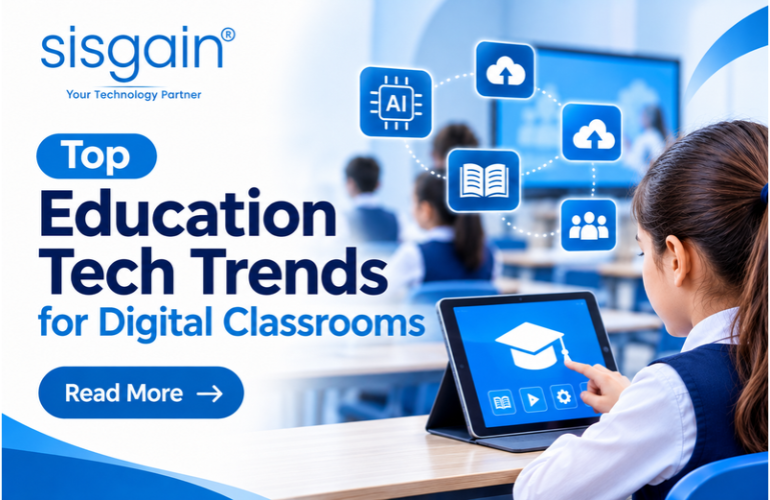

Walk into a classroom in the United States today and the change is hard to miss. Interactive displays have joined the whiteboard, tablets sit beside textbooks, and assignments travel between students and teachers through cloud platforms instead of paper folders.
AI-powered tools, cloud platforms, and interactive technologies are pushing schools toward learning that is personalized, flexible, and responsive to individual needs. At the same time, leaders must weigh cost, privacy, and teacher readiness. This guide explores the major education technology trends expected to influence digital classrooms in 2026 and beyond, with practical examples and an honest look at the challenges behind each one.
Quick definition: A digital classroom is a learning environment where instruction, practice, communication, and assessment happen through connected technology, either alongside or in place of traditional face-to-face methods.
1. AI-Powered Personalized Learning
How Artificial Intelligence Is Transforming Student Learning
Artificial intelligence is moving from a novelty to a working classroom tool. AI-powered learning assistants and intelligent tutoring systems can walk a student through a math problem step by step, adjusting explanations when the student struggles. Recommendation engines suggest the next lesson or practice set based on recent performance, so a student who has mastered fractions is not held back and one who has not is not rushed forward.
AI also streamlines routine feedback. Automated assessments can grade multiple-choice quizzes instantly, and writing tools can flag grammar or structural issues before a teacher ever opens the draft. Perhaps most valuable, analytics can reveal learning gaps that are easy to miss in a class of thirty, such as a recurring misconception about a single concept.
Benefits of AI-Driven Education
- Individualized pacing: Students receive practice that matches their level.
- Stronger engagement: Instant feedback keeps learners moving instead of waiting days for results.
- Less administrative work: Teachers spend fewer hours on grading and more on instruction.
- Broader support: Adaptive tools can help students with different learning abilities and needs.
Expert insight: AI works best when it supports teachers rather than replaces them. A tutoring tool can explain a concept ten different ways, but it cannot notice that a student seems discouraged or needs encouragement. Responsible adoption means human oversight of AI recommendations, transparency about how tools make decisions, and clear policies on acceptable student use.
2. Immersive Learning with AR and VR
Making Digital Classrooms More Interactive
Virtual reality places students inside an experience, while augmented reality layers digital information over the physical world. Together they turn abstract ideas into something learners can see and manipulate. Students can walk through an ancient city, rotate a 3D model of a molecule, or run a science experiment in a virtual laboratory where a mistake costs nothing.
These interactive 3D environments are especially useful for topics that are too small, too distant, too dangerous, or too expensive to demonstrate in person.
Real-World Applications of Immersive Technology
- Medical and science education: Anatomy and biology simulations.
- Engineering and technical training: Practice with equipment before touching the real thing.
- Geography, history, and environmental studies: Visits to places and eras that are otherwise out of reach.
- Virtual field trips: Collaborative exploration that does not depend on a bus budget.
Practical example: Consider a high school biology class without a dissection budget. With a VR or AR anatomy app, students can peel back the layers of the human body, isolate the circulatory system, and repeat the exploration as often as needed. A chemistry class can mix volatile compounds in a virtual lab, observe the reactions safely, and review what went wrong, all without purchasing a single beaker.
3. Cloud-Based Learning Management Systems
Centralizing Digital Learning Activities
A learning management system, or LMS, is the digital hub of many classrooms. Teachers publish course content, set deadlines, collect assignments, and grade work in one place. Students see what is due and how they are progressing, while parents and administrators gain visibility into the bigger picture. Built-in messaging and discussion boards keep communication between teachers and students organized rather than scattered across email threads.
Why Cloud-Based Education Platforms Matter
- Access anywhere: Students can learn from school, home, or the library.
- Real-time updates: Changes to a syllabus or a grade appear immediately.
- Easy integration: Cloud platforms connect with a growing ecosystem of educational apps.
- Scalability: The same platform can serve a single school, a district, or a university system.
The quality of the platform depends heavily on how well it is built. Institutions that want something tailored, such as custom assessments, specialized reporting, or integration with existing systems, often work with an elearning development company uae or a comparable specialist abroad to design scalable platforms and cloud-based learning environments. Whatever the partner, the goal is the same: a system that teachers find intuitive and that grows with the institution.
4. Gamification and Interactive Learning
Turning Traditional Lessons into Engaging Experiences
Gamification borrows the motivating elements of games and applies them to learning. Educational quizzes and interactive challenges replace some worksheets. Digital badges and achievement systems recognize milestones, and leaderboards or progress bars show learners how far they have come. Game-based activities can also be collaborative, with teams solving problems together rather than competing against each other.
How Gamification Improves Student Engagement
- Active participation: Students who might stay quiet in a discussion often join a quiz game.
- Learning through practice: Repeated attempts feel less like failure and more like progress.
- Healthy motivation: Friendly competition can energize a classroom.
- Useful data: Teachers can see which topics trip up the whole class.
Expert insight: Points and rankings are only a means to an end. If students chase badges rather than understanding, the design has failed. Effective gamification ties rewards to genuine mastery, offers meaningful feedback on mistakes, and avoids public leaderboards that can discourage students who are already struggling.
5. Smart Classrooms and IoT Integration
The Growing Role of Connected Classroom Technology
Smart classrooms combine interactive smartboards, digital displays, and IoT-enabled equipment into a connected environment. Sensors and connected devices can automate attendance, adjust lighting and temperature, and manage energy use without teacher intervention. Students can share their screens wirelessly, and teachers can control displays from a tablet while moving around the room.
Benefits of Smart Classroom Infrastructure
- Better classroom management: Routine tasks happen automatically.
- Improved presentations: Content moves smoothly between devices.
- Efficient resource use: Energy and equipment are managed intelligently.
- Collaboration: Students can contribute from their own devices.
Practical example: Imagine a middle school teacher who begins class by tapping a single dashboard. Attendance is recorded as students connect, the smartboard loads today’s lesson, and a quiz is pushed to student tablets. During the lesson, the teacher shares a student’s work to the display for discussion. Because everything runs through one centralized platform, less time is lost to logging in, switching cables, or troubleshooting, and more time goes to teaching.
6. Data Analytics and Predictive Learning
Using Educational Data to Improve Learning Outcomes
Every click, quiz, and submission produces data. When organized well, that data becomes actionable. Student performance dashboards show where individuals and groups stand. Engagement analysis reveals whether students are logging in, completing readings, or falling behind. Curriculum teams can see which units consistently produce weak results and revise them accordingly.
How Predictive Analytics Supports Educators
Predictive models look for patterns that precede academic trouble, such as a drop in assignment completion or declining quiz scores. This allows advisors and teachers to reach out early, rather than discovering a problem at the end of a semester.
- Early support: Students who need help are identified sooner.
- Tailored recommendations: Suggestions reflect each student’s progress.
- Better monitoring: Teachers can track growth over time.
- Informed decisions: Choices rest on evidence rather than instinct alone.
Important consideration: Analytics are only as good as the data behind them. Incomplete or biased data can produce misleading predictions, and a flag should prompt a conversation, never a label. Institutions should be transparent with families about what is collected, ensure that humans review automated recommendations, and handle student information responsibly.
7. Mobile Learning and Microlearning
Making Education Accessible Through Mobile Technology
Smartphones and tablets put learning in a student’s pocket. Mobile-friendly applications let learners read, watch, practice, and submit work from almost anywhere. Offline modes and downloadable resources help when connectivity is unreliable, and notifications nudge students about upcoming deadlines or unfinished lessons.
Why Microlearning Is Becoming Important
Microlearning breaks content into short, focused pieces. A five-minute video, a bite-sized module, or a quick knowledge check can fit into a bus ride or a lunch break.
- Short educational videos and lessons.
- Bite-sized modules focused on one idea.
- Quick assessments that reinforce memory.
- Flexible schedules that respect busy lives.
USA-focused angle: In the United States, access gaps are real. Students in rural and remote communities may live far from campus or have limited home broadband. Working adults and community college students often study around jobs and family obligations. Mobile learning, especially with offline options, gives these learners a way to keep progressing on their own schedule. Equity still matters, however, because not every student owns a device, and schools must plan for that gap.
8. Automated School Administration
Digital Transformation of School Management
Behind every classroom is an administrative engine, and it is increasingly digital. Automated attendance and student records reduce data entry. Online admissions and enrollment replace paper forms and long lines. Digital fee collection tracks payments without manual reconciliation, and parent-teacher communication portals keep families informed. Staff scheduling and academic administration tools help leaders coordinate people and resources.
The Role of Integrated Education Management Platforms
The real value appears when these functions share a single platform rather than operating as disconnected tools.
- Centralized information: One record for each student.
- Reduced workload: Fewer duplicate entries and fewer errors.
- Better communication: Teachers, parents, and administrators see the same information.
- Smarter decisions: Leaders see enrollment, attendance, and finance in context.
Education leaders around the world are building these platforms, and international EdTech development expertise offers useful lessons for US institutions. An education management system dubai providers have developed, for example, shows how admissions, records, and communication can be unified in a single environment. Similarly, a school management software dubai schools use to automate attendance, fees, and student information illustrates how much routine work can be removed from staff workloads.
When institutions are ready to build or customize such tools, evaluating experienced partners matters. Reviewing lists of the best educational software development companies in uae can help decision-makers understand what to look for, including portfolio depth, security practices, and long-term support. These international examples are illustrations of development approaches, not US market data, and any vendor must still be vetted against US requirements.
9. Cybersecurity and Data Privacy in Digital Education
Protecting Student and Institutional Information
As learning moves online, so do the risks. Schools hold sensitive information about children, families, and finances, which makes them attractive targets. Protecting that information requires layered safeguards:
- Secure student information systems with role-based permissions.
- Data encryption in storage and transit.
- Multi-factor authentication for staff and administrators.
- Secure cloud infrastructure with tested backups.
Addressing Cybersecurity Challenges in US Schools
US schools face phishing, ransomware, and attempts at unauthorized access. They must also comply with the Family Educational Rights and Privacy Act (FERPA) and applicable state student privacy laws, which govern how student records are collected, shared, and protected. The growing use of AI adds another layer, because tools that collect student data must do so responsibly, with clear limits on what is gathered and how it is used.
Expert insight: Security cannot be an afterthought. Educational software should be designed with privacy and protection from the planning stage, including data minimization, access controls, vendor reviews, and incident response plans. Retrofitting security after launch is more expensive and far less effective. Regular staff training also matters, because a single convincing phishing email can bypass sophisticated technology.
10. Future of Digital Classrooms in the USA
Emerging Developments Beyond 2026
Several developments are likely to shape the next phase:
- More capable AI learning assistants that explain, question, and coach.
- Wider adoption of immersive technologies as hardware becomes more affordable.
- Interoperable platforms that share data securely across tools.
- A stronger focus on accessibility and inclusive design.
- Clearer governance for responsible AI use and digital safety.
Preparing Educational Institutions for the Future
- Invest in scalable infrastructure, including reliable networks and cloud services.
- Train teachers to use new tools confidently and critically.
- Evaluate tools by measurable outcomes, not marketing claims.
- Prioritize privacy, security, and accessibility in every purchase.
Contact SISGAIN Technologies today to transform your digital education experience with innovative technology solutions!
Conclusion
US educational institutions should adopt solutions based on student needs, institutional goals, security, and long-term scalability rather than novelty alone. By pairing careful planning with human-centered teaching, the latest education technology trends can build learning environments that are more accessible, engaging, and effective for every learner.
Frequently Asked Questions
What are the latest education technology trends in 2026?
Key trends include AI-powered learning, AR and VR, cloud-based platforms, smart classrooms, learning analytics, and mobile education. Together they make learning more personalized, flexible, and data-informed.
How is AI transforming digital classrooms?
AI enables personalized learning paths, automated assessments, intelligent tutoring, and ongoing monitoring of student performance. Teachers remain essential for oversight and human connection.
What are the benefits of digital classroom technology?
Benefits include improved accessibility, stronger student engagement, easier collaboration, flexible learning options, and greater administrative efficiency.
How do learning management systems improve education?
They centralize course materials, track assignments, support online assessments, and streamline communication among teachers, students, and families.
What should schools consider before adopting new education technology?
Schools should weigh scalability, integration with existing tools, cybersecurity, student privacy, accessibility, teacher training, and total cost.