



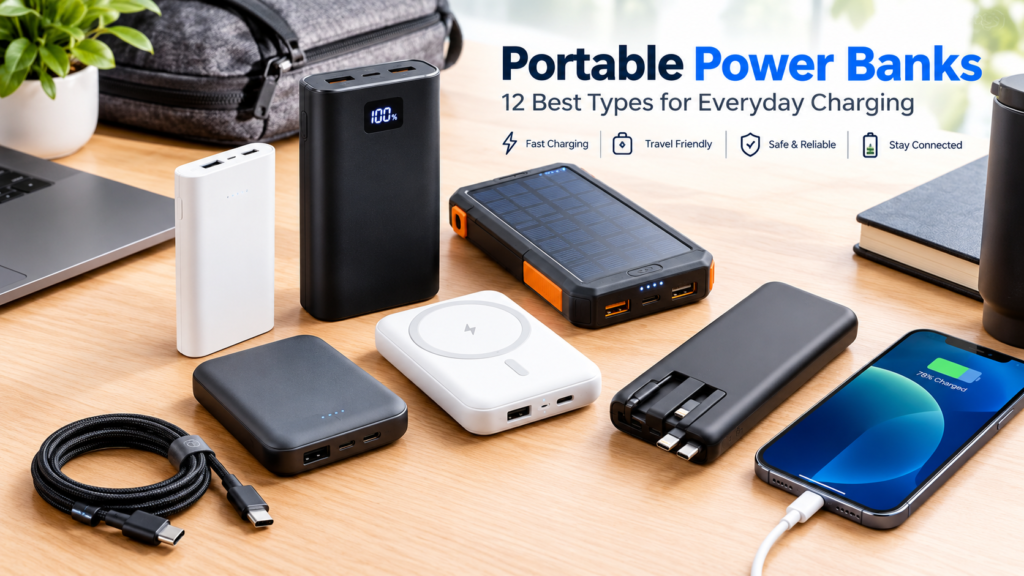

Portable Power Banks are useful accessories for keeping smartphones and other compatible devices charged when a wall outlet is unavailable. Whether you are travelling, commuting, working outdoors, or dealing with power interruptions, a suitable power bank can provide convenient backup power. From compact mini power banks to high-capacity models and wireless charging options, there are many choices to suit different lifestyles and budgets.
In this guide, we explore 12 types of power banks, their key features, and how to choose the right option for your everyday charging needs.
1. Compact Mini Power Banks
Mini power banks are designed for people who want a lightweight charging solution that fits easily into a pocket, handbag, or small backpack. They are particularly useful for short outings and emergencies when your phone battery is running low.
Many compact models include USB-C or built-in connectors, depending on the design.
Key benefits:
- Lightweight and easy to carry.
- Suitable for everyday commutes.
- Require little storage space.
- Useful for occasional battery top-ups.
Check the actual battery capacity and output power before buying, as compact size usually means less stored energy than larger models.
2. High-Capacity Power Banks
High-capacity power banks store more energy than compact alternatives. They can be helpful for long journeys, extended outdoor activities, or charging several devices throughout the day.
Some models include multiple USB ports, allowing you to connect more than one compatible device.
Features to compare:
- Advertised battery capacity.
- USB-C power output.
- Number of charging ports.
- Weight and dimensions.
- Battery protection features.
Remember that the amount of energy delivered to your devices is lower than the advertised capacity because of conversion losses.
3. Fast-Charging Power Banks
Fast-charging power banks are designed to recharge compatible devices more quickly than lower-powered alternatives. Depending on the model, they may support USB Power Delivery (USB-PD), Quick Charge, or other charging technologies.
For the best results, your phone, cable, and power bank must support a compatible fast-charging standard.
Before purchasing, compare the maximum output wattage and check whether the power bank supports your device’s requirements. A high wattage rating alone does not guarantee faster charging for every phone.
4. Wireless Power Banks
Wireless power banks charge compatible smartphones without requiring a cable to connect directly to the phone. You place the phone on the designated charging surface and align it according to the manufacturer’s instructions.
This design can be convenient when travelling or when you want to reduce cable clutter.
Advantages include:
- Convenient cable-free charging.
- Fewer separate accessories to carry.
- Useful for compatible smartphones.
- Available in compact and larger designs.
Wireless charging can generate more heat and lose more energy than wired charging. Check device compatibility and the supported wireless charging standard before buying.
5. Magnetic Power Banks
Magnetic power banks attach to compatible phones or cases to help keep the charging unit aligned. Certain models are designed for MagSafe-compatible iPhones, while others use different magnetic arrangements.
They can be convenient for charging while travelling or using your phone for everyday tasks.
Check whether your smartphone supports the relevant wireless charging system and whether a compatible magnetic case is needed. Magnetic attachment does not automatically guarantee fast charging or compatibility with every device.
6. Solar Power Banks
Solar power banks include small solar panels intended to convert sunlight into electrical energy. They are marketed for camping, hiking, and other outdoor activities where access to a power outlet may be limited.
However, built-in panels are often small, so recharging a power bank using sunlight alone can take a long time.
Before buying, consider:
- Battery capacity.
- Solar panel size.
- USB charging options.
- Weather resistance.
- Durability and portability.
For most users, charging the power bank from a wall outlet beforehand is more practical. Treat the solar panel as a supplementary charging option rather than a guaranteed power source.
7. Power Banks with Built-In Cables
Power banks with built-in cables reduce the need to carry a separate charging cable. Some models include more than one connector or provide a cable that stores neatly inside the body.
They can be especially useful for commuters and travellers who prefer an all-in-one accessory.
Check which connector types are included and whether the cable supports your device’s required charging speed. Also consider whether the cable can be replaced if it becomes damaged.
8. Power Banks with Multiple Ports
Multi-port power banks allow you to charge several compatible devices from one battery pack. Depending on the model, you may be able to connect a smartphone, earbuds, tablet, or another device at the same time.
They are useful for families, travellers, and people who carry multiple electronics.
Before choosing a model, check its total output and the power available from each port. Some power banks reduce the output available to individual devices when several ports are used simultaneously.
9. USB-C Power Banks
USB-C power banks use a widely adopted connector found on many modern smartphones, tablets, and other electronics. Depending on the specifications, a USB-C port may support both input and output, allowing the power bank to recharge and charge other devices.
Some models support USB-PD for compatible devices.
Why consider one?
- Convenient compatibility with many modern devices.
- Potential support for fast charging.
- Reversible connector design.
- Useful for a range of electronics.
Check the power bank’s input and output ratings. A USB-C connector alone does not guarantee a particular charging speed or power level.
10. Power Banks for Tablets
Tablets generally have larger batteries than smartphones, so they may require a power bank with greater capacity and higher output power.
Some models can also charge compatible laptops, but this requires sufficient wattage and support for the laptop’s charging standard.
When selecting a power bank for a tablet, compare the required charging power, available capacity, connector type, and weight. If you plan to charge a laptop as well, confirm compatibility with the manufacturer’s specifications.
11. Power Banks with Digital Displays
Some power banks include a digital screen showing an estimated battery percentage, output status, or other charging information.
A display can make it easier to decide when the power bank needs recharging and to monitor its remaining capacity.
The information shown depends on the model, and the percentage may be an estimate rather than a precise measurement of usable energy.
Look for a clear display, straightforward controls, and reliable charging specifications rather than choosing a product based on the screen alone.
12. Rugged Power Banks for Outdoor Use
Rugged power banks are designed for people who spend time camping, hiking, travelling, or working outdoors. Certain models feature reinforced cases, protective covers, or ratings for resistance to dust and water.
These features can improve suitability for outdoor use, but protection varies between products.
Check the exact ingress-protection rating, impact-resistance claims, operating temperature limits, and warranty terms. Even a rugged power bank should be kept away from excessive heat, direct flame, and conditions outside its stated limits.
How to Choose the Best Portable Power Banks
Choosing the right power bank depends on your devices, daily routine, and charging expectations.
1. Check Battery Capacity
Capacity is commonly advertised in milliamp-hours (mAh). A larger number generally indicates more stored battery charge, but it does not directly tell you how many full phone charges you will get.
Actual results depend on voltage conversion, efficiency, your phone’s battery size, and how you use your devices while charging.
2. Compare Output Power
Check the maximum output wattage and supported charging standards. If your phone supports fast charging, select a power bank that supports a compatible standard and use an appropriate cable.
3. Consider Size and Weight
A small power bank is easier to carry, while a larger model usually offers more capacity. Choose a balance that suits your travel habits and daily needs.
4. Look for Safety Features
Choose reputable products with clearly stated specifications and appropriate protection against overcurrent, overvoltage, short circuits, and overheating.
Stop using a power bank if it becomes swollen, leaks, smells unusual, or shows signs of physical damage.
5. Check Charging and Recharging Time
A power bank’s own recharge time depends on its input power, capacity, and charging technology. If you regularly use a high-capacity model, a compatible fast input can reduce the time needed to recharge it.
6. Review Travel Restrictions
Airlines commonly require power banks to be carried in cabin baggage rather than checked baggage. Capacity restrictions and approval requirements can vary by airline and jurisdiction, so check the current rules before travelling.
Common Power Bank Mistakes to Avoid
- Buying a power bank without checking phone compatibility.
- Assuming advertised capacity equals usable output.
- Expecting every USB-C power bank to support fast charging.
- Choosing a large model without considering its weight.
- Leaving a power bank in a hot vehicle or direct sunlight.
- Using damaged cables or a visibly damaged battery pack.
- Ignoring airline restrictions when travelling.
- Buying products with unclear specifications or questionable safety claims.
Following the manufacturer’s instructions and choosing a power bank suited to your devices can help make portable charging safer and more convenient.
Frequently Asked Questions
What is a portable power bank used for?
A portable power bank stores electrical energy and allows you to recharge compatible devices when a wall outlet is unavailable. It is commonly used with smartphones, earbuds, tablets, and other USB-powered electronics.
How many times can a power bank charge a phone?
The number of charges depends on the power bank’s usable energy, the phone’s battery capacity, and conversion losses. A higher-capacity model will generally provide more charging energy, but the exact number varies by device and conditions.
Are fast-charging power banks worth buying?
They can be worthwhile if your phone supports a compatible fast-charging standard. Check the power bank’s output, your phone’s supported charging technology, and the cable specifications before purchasing.
Can a power bank charge an iPhone or Android phone?
Yes, provided the connectors, charging standards, and power output are compatible. Wireless and magnetic models may have additional compatibility requirements.
Are solar power banks effective?
Solar power banks can provide supplementary charging outdoors, but small built-in panels may take a long time to replenish the battery. Charging the unit from a wall outlet before leaving is generally more dependable.
Where can I buy portable power banks in Pakistan?
You can explore online retailers such as Trendigo.pk for mobile accessories and portable charging products. Compare capacity, charging speed, safety features, and warranty information before making a purchase.
Conclusion
Portable power banks offer a convenient way to keep your devices charged at home, at work, and while travelling. From mini power banks and fast-charging models to wireless chargers and rugged outdoor options, there is a design for different charging needs.
Before buying, consider battery capacity, output power, portability, device compatibility, and safety. Choosing the right model can help you stay connected without depending entirely on nearby power outlets.
Explore Trendigo.pk for useful technology accessories and everyday gadgets that support your mobile lifestyle.
