



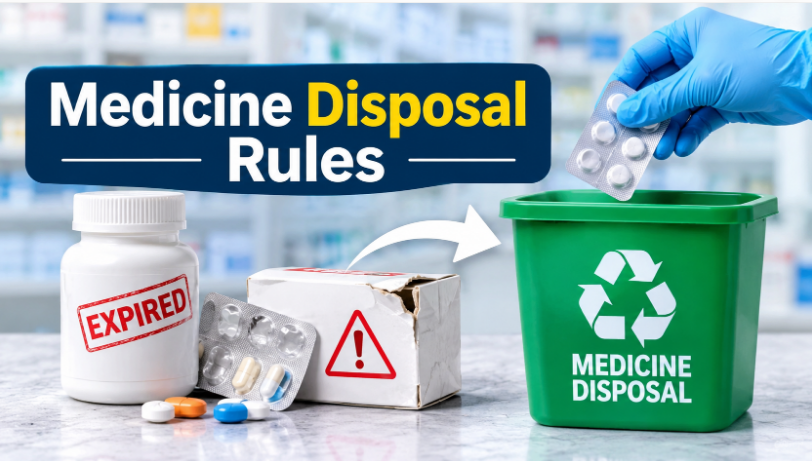

Miriam ran a pharmacy in Murang’a, and for years the disposal of expired medicine had been a small, unglamorous chore that she handled at the back of the shop. When a box passed its date, it went into a black bin bag, and the bag went out with the general rubbish on collection day. Broken blister packs, leaking bottles, and boxes soaked in a rainstorm went the same way. She had never thought of it as a serious matter. Then a neighbour who worked for the county environment office mentioned, in passing, that the bins behind the shops were sometimes picked through by children and people searching for things to sell. Miriam felt a cold jolt. Some of those medicines were still in their foil, and some were controlled products that should never have been in a general bin at all.
She went home that evening and read everything she could find about how pharmacies in Kenya were expected to dispose of their waste. What she found was not a single simple rule, but a set of requirements spread across the pharmacy regulator, the environmental authority, and the county health and waste services. Each had something to say, and the pharmacy was responsible for making sure all of it was followed.
This post is a general guide to handling expired and damaged medicines in a Kenyan pharmacy. It is important to say at the outset that the specific rules on disposal, destruction, record keeping, and waste handling are set by the Pharmacy and Poisons Board, the National Environment Management Authority, county governments, and other relevant bodies, and that they may change. Nothing here should be taken as the current official position. The aim is to help owners build a sound process, understand what they are responsible for, and check the details with the authorities directly.
Why disposal matters
Expired and damaged medicines are not ordinary rubbish. They can be harmful if they reach the wrong hands, and they can cause environmental damage if they are dumped carelessly. Some medicines can contaminate soil and water. Others may be misused, sold on informally, or taken by children who find them. Controlled and regulated products carry additional risk, and the law demands that they be accounted for and destroyed in a documented way.
There is also a financial side. A pharmacy that disposes of stock without records cannot show where its losses went, and that makes stock control and audits harder. A pharmacy that returns stock to a supplier correctly may recover part of its cost, while one that throws it away loses everything.
Miriam’s first step was to separate her waste into categories. She made a list of the types she produced: expired tablets and capsules, damaged or leaking liquids, broken packaging, expired controlled products, sharps, and general packaging. Each category, she realised, could require a different route.
Start with a written procedure
Every pharmacy should have a written procedure for handling expired and damaged stock. It should explain how items are identified and removed from sale, how they are stored while awaiting disposal, who is responsible for each step, how they are recorded, and how they leave the premises. Keep the procedure short enough that staff will read it, and display a copy near the storeroom.
Miriam’s procedure began with a rule she had not previously followed: expired or damaged products are removed from the shelves at the time they are found, not when the weekly stock check happens to reach them. They go into a clearly labelled quarantine box in the storeroom. A record is made on a log sheet showing the product, the batch, the quantity, the reason, and the date. Only then can the item be moved to the disposal area.
Know the difference between return and destruction
Not every expired product must be destroyed on site. Where a supplier accepts returns, the pharmacy may be able to send the stock back for proper disposal and, in some cases, a credit. Check the terms of each supplier agreement, and ask whether returns are accepted for expired stock, damaged stock, or both. Keep a copy of the return note, and obtain the supplier’s confirmation of receipt.
Where a return is not possible, the product must be destroyed in a way that the regulator accepts. Destruction usually must be carried out by a licensed contractor or in a manner approved by the authorities, and it must be recorded. Do not assume that a family member or a casual collector is an acceptable route, however well meant.
Controlled and regulated products have special requirements. Confirm with the Pharmacy and Poisons Board how they must be counted, stored, witnessed, and destroyed, and keep records that show the chain of custody from the shelf to the final disposal. A discrepancy in a controlled product’s record is a serious matter, and it must be explained.
Miriam wrote to the Board and asked for the procedure for controlled products in writing. The reply set out the witnessing requirement, the form to be used, and the timeframe for reporting. She keeps it in her compliance folder, and she checks it each year.
Store waste safely while it waits
Waste awaiting disposal needs its own storage area. It should be secure, clearly labelled, kept away from customers and from food, protected from rain and sun, and inaccessible to children and animals. A locked cupboard or a caged area works well for controlled products and anything that could be misused.
Keep different categories separate. Expired tablets should not sit beside broken glass bottles, and sharps should never be mixed with general packaging. Use containers that are suitable for each category, and label them clearly. Check the storage area regularly, and remove anything that should have gone.
Miriam replaced her black bin bags with labelled containers and moved the disposal area inside a locked store behind the shop. The change cost little, but it took the risk of scavenging out of the equation.
Use licensed collection where it is required
Many counties and national authorities require waste that is hazardous or regulated to be collected by licensed contractors. Ask your county environment office which licensed collectors operate in your area, and whether they accept pharmaceutical waste. Check that any contractor holds the correct licence, and ask for a written agreement that sets out what they will collect, how often, and how it will be recorded.
Keep every collection note and every certificate of destruction. These records are the evidence that the waste was handled properly, and they should be retained for the period the authorities require. A pharmacy that cannot produce them during an inspection will struggle to show that its disposal was lawful.
Miriam found that the nearest licensed collector served a wide area and charged for each collection. She agreed a monthly schedule that matched the volume she produced, and she asked for a copy of the destruction record each time. The arrangement gave her the paperwork she needed and removed the worry from her mind.
Handle sharps and packaging with care
Sharps, such as used needles and lancets, need a separate route. They should be placed in puncture-resistant containers as soon as they are used, and the containers should be sealed and labelled before they leave the point of use. Do not place sharps in general waste, and do not attempt to reuse or recap them. Arrange collection through a licensed route that handles them safely.
Packaging is often overlooked. Cardboard boxes, blister foils, and plastic bottles may be recyclable, but only if they are clean and free of medicine residue. Check with your local recycling and waste authorities before setting up any recycling arrangement, and keep packaging that could identify a patient or a product separate until it has been dealt with.
Keep records that tell the whole story
Disposal records are part of the pharmacy’s compliance file. For each item or batch removed, record the product name, strength, batch number, expiry date, quantity, reason for removal, date removed, storage location, method of disposal, date of disposal, and the name of the person responsible. Where a witness is required, record the witness’s name and signature. Store the records securely, and make sure they can be produced when an inspector asks.
Reconcile disposal records against stock records each month. An item that appears in the disposal log but still shows in the stock system, or the reverse, needs to be investigated and corrected.
Miriam’s log now has a single page for each batch, and she reviews it every month with her pharmacist. The reconciliation has shown her two places where expired stock had been removed but not recorded, and she has closed those gaps.
Train the team
Everyone who handles stock should know the disposal procedure. Train new staff on what counts as expired or damaged, how to quarantine an item, and where it goes next. Make sure they know that a damaged package should be dealt with immediately, not left on the shelf in case it is needed.
Repeat the training each year, and refresh it when the procedure changes. Staff who understand why disposal matters are far less likely to take shortcuts.
Supply and the stock you hold
Careful ordering reduces the amount of waste a pharmacy produces. Buy in quantities that match your sales, check the expiry dates on arrival, and speak to suppliers about returns and short-dated stock before a problem arises. A supplier who accepts returns for expired stock and provides clear documentation makes the disposal process far easier.
If you are looking for exporters who understand the Kenyan market and its import requirements, and who can provide steady, documented supply with clear terms for returns and expiry, you can review the options at pharma exporter to Kenya. Verify product registration, certification, and documentation before committing, and confirm current import rules with the relevant authorities.
What Miriam changed
Miriam’s pharmacy now handles expired and damaged stock as a controlled process. Items are quarantined at once, logged, stored safely, and collected by a licensed contractor on a set schedule. Controlled products follow a witnessed route, the records are reconciled monthly, and the staff know the procedure. The black bin bags are gone.
She says the most important change was not the procedure itself. It was the realisation that disposal is part of the pharmacy’s duty to its community, and that what happens to a box after it leaves the shelf matters as much as what happens before it is sold.
Practical wisdom for owners
Disposing of expired and damaged medicines is a responsibility that runs from the shelf to the final destruction. Write a clear procedure, quarantine stock at once, and choose between supplier return and licensed destruction according to the rules. Store waste securely, use licensed collection where it is required, and handle sharps and packaging with care. Keep records that show the whole journey, reconcile them each month, and train your team. The exact requirements for controlled products, destruction, and waste must always be confirmed with the Pharmacy and Poisons Board, the National Environment Management Authority, and your county authorities, because they change. A pharmacy that disposes of its waste properly protects its community as well as its own licence.


