


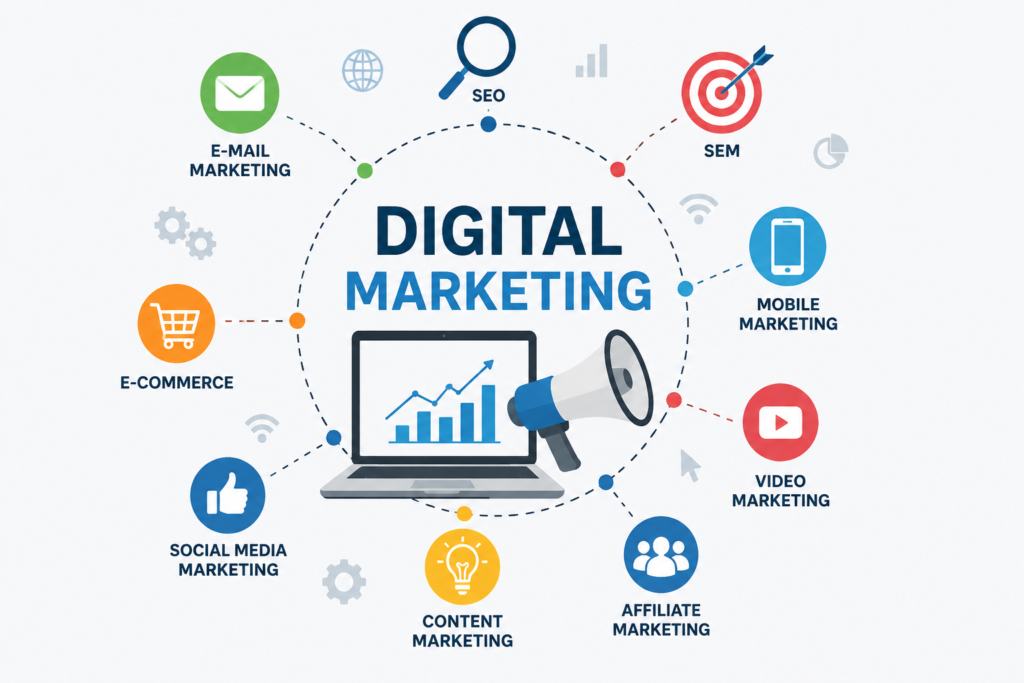

Digital Marketing for Beginners: A Complete Guide for 2026
Digital marketing has become an essential part of growing a business in today’s online world. Whether you are a small business owner, freelancer, student, or someone planning to start an online business, understanding digital marketing can help you reach the right audience and build a strong online presence.
In simple terms, digital marketing means promoting products, services, or brands through digital channels such as search engines, websites, social media, email, and online advertising. Unlike traditional marketing, digital marketing allows businesses to communicate with specific audiences and measure the results of their campaigns.
What Is Digital Marketing?
Digital marketing is the use of online platforms and digital technologies to promote a business, product, or service. It includes several different methods, each designed to attract potential customers, build trust, and encourage people to take action.
Some of the most common areas of digital marketing include:
- Search Engine Optimization (SEO)
- Content Marketing
- Social Media Marketing
- Email Marketing
- Search Engine Marketing (SEM)
- Pay- Per – Click (PPC) advertising
- Affiliate Marketing
- Influencer Marketing
- Video Marketing
A successful digital marketing strategy often combines several of these methods rather than relying on just one.
Why Is Digital Marketing Important?
People spend a significant amount of time online researching products, comparing services, reading reviews, and communicating with brands. This makes having an online presence extremely important for businesses.
Digital marketing can help businesses:
- Reach a wider audience
- Build brand awareness
- Generate leads
- Increase website traffic
- Communicate directly with customers
- Measure marketing performance
- Develop long – term customer relationships
Another advantage is flexibility. Businesses can test different campaigns, analyze their performance, and make changes based on the results.
1. Start With Search Engine Optimization
Search Engine Optimization, commonly known as SEO, is the process of improving a website so that it can appear more prominently in search engine results.
For beginners, SEO starts with understanding what potential customers are searching for. Businesses can then create useful content that answers those questions.
Basic SEO practices include:
- Researching relevant keywords
- Creating useful and original content
- Writing clear page titles and descriptions
- Improving website speed and usability
- Making websites mobile – friendly
- Building relevant and trustworthy links
- Organizing content with useful headings
SEO usually takes time, but it can provide long – term benefits when it is approached consistently and naturally.
2. Create Valuable Content
Content marketing focuses on creating and sharing useful information for a specific audience. Content can take many forms, including blog posts, videos, guides, infographics, podcasts, and social media posts.
Instead of constantly trying to sell something, businesses should create content that helps people solve problems or answer questions.
For example, a digital marketing agency could publish articles about SEO, social media strategies, website optimization, and online advertising.
Good content can help establish credibility and encourage people to return to a website or follow a brand.
3. Use Social Media Marketing
Social media platforms provide businesses with opportunities to communicate directly with their audiences.
The key is not to be present on every platform. Beginners should focus on the platforms where their target audience is most active.
A social media strategy may include:
- Educational posts
- Short videos
- Customer stories
- Industry tips
- Behind – the – scenes content
- Polls and questions
- Product or service updates
Consistency is important, but quality should come before simply posting as often as possible.
4. Learn the Basics of Email Marketing
Email marketing allows businesses to communicate directly with people who have chosen to receive their messages.
A business can use email to share useful information, newsletters, product updates, special offers, and educational content.
A good email strategy starts with permission and provides a clear reason for subscribers to remain interested. Messages should be relevant, easy to read, and valuable to the recipient.
5. Understand Paid Advertising
organic marketing methods can take time to produce results. Paid advertising can help businesses reach potential customers more quickly.
Common forms of online advertising include search ads, social media advertising, display advertising, and video advertising.
However, beginners should avoid spending money without a clear objective. Before launching an advertisement, determine:
- Who is the target audience?
- What action should they take?
- What is the advertising budget?
- How will success be measured?
Starting with a small, controlled campaign can be a better approach than spending a large amount immediately.
6. Build a Strong Website
A website is often the central part of a digital marketing strategy. It provides a place where people can learn about a business, explore its products or services, and contact the company.
A good website business should be:
- Easy to navigate
- Mobile – friendly
- Fast to load
- Clear and professional
- Simple to understand
- Focused on the needs of visitors
Every important page should also have a clear purpose and an appropriate call to action.
7. Measure Your Results
One of the biggest advantages of digital marketing is the ability to measure performance.
Important metrics may include website traffic, search visibility, engagement, leads, conversion rates, email performance, and advertising results.
Instead of focusing only on the number of views and followers, businesses should pay attention to whether their marketing activities are helping achieve meaningful goals.
For example, if the goal is generating leads, the number and quality of leads may be more important than simply increasing social media followers.
8. Keep Learning and Adapting
Digital marketing changes continuously. Search engines update their systems, social media platforms introduce new features, and consumer behavior evolves.
For this reason, digital marketers should continue learning and experimenting.
Follow reliable industry resources, study campaign results, test new ideas, and pay attention to what your audience responds to. At the same time, avoid chasing every new trend. A strategy should always support a clear business objective.
A Simple Digital Marketing Plan for Beginners
If you are completely new to digital marketing, you do not need to start with everything at once.
Begin with these steps:
Step 1: Define your target audience.
Step 2: Set one or two clear marketing goals.
Step 3: Create a simple, useful website or landing page.
Step 4: Research topics and keywords your audience cares about.
Step 5: Publish helpful content regularly.
Step 6: Choose one or two relevant social media platforms.
Step 7: Build an email audience where appropriate.
Step 8: Consider paid advertising once you understand your goals and audience.
Step 9: Measure your results.
Step 10: Improve your strategy based on the data.
Final Thoughts
Digital marketing can seem complicated when you first encounter terms such as SEO, PPC, conversion rates, analytics, and content marketing. However, the basic idea is simple: understand your audience, provide useful information, reach people through the right digital channels, measure what works.
Beginners do not need to master every digital marketing technique immediately. Start with the fundamentals, focus on providing genuine value, and gradually develop your skills. With consistent learning and testing, digital marketing can become a powerful way to build an online presence and support long – term business growth.