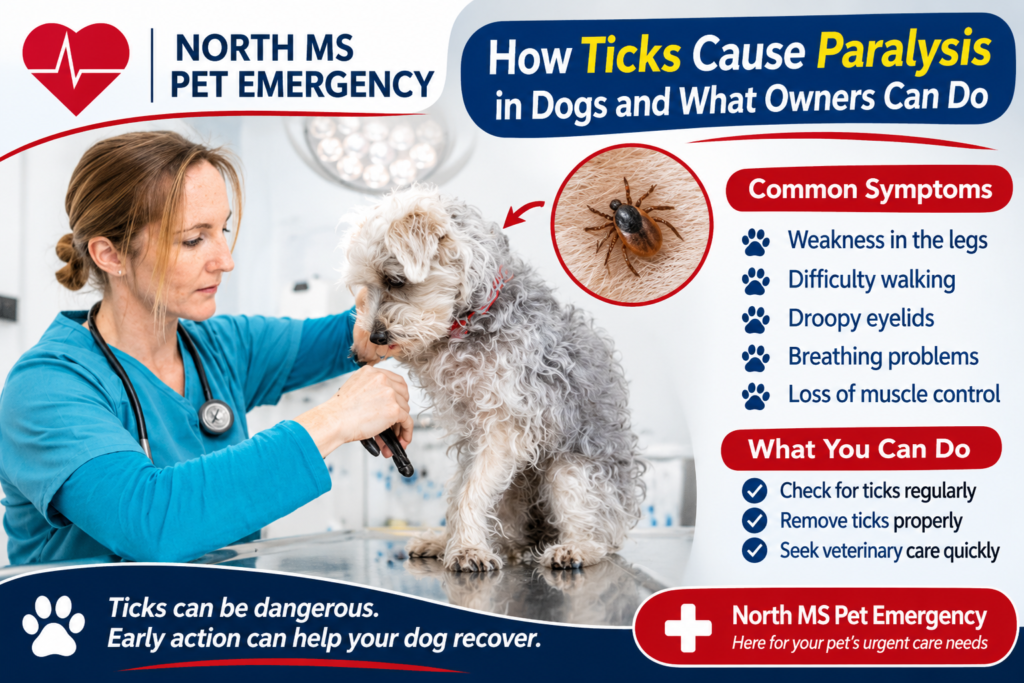

Most dog owners think of ticks as a nuisance that carries diseases such as Lyme disease or Ehrlichiosis. Fewer know that the link between ticks and paralysis in dogs is a separate and potentially life threatening problem. It is not caused by an infection. It is caused by a neurotoxin that certain female ticks release in their saliva while they feed. As the toxin builds up, it interferes with the way nerves communicate with muscles, and a dog that seemed healthy two days earlier can lose the ability to stand. The condition is largely reversible when the tick is found and removed in time, which is why understanding how it develops gives you a real advantage. This guide explains the biology, the stages of illness, the correct way to check and remove ticks and the point at which emergency treatment becomes necessary.
How a Tick Bite Turns Into Paralysis
The Role of the Tick’s Saliva
When a female tick attaches to a dog, she feeds slowly over several days. During that time her salivary glands release a mixture of substances that keep the wound open, prevent clotting and suppress local inflammation. In the species that cause paralysis, this saliva also contains a neurotoxin. The toxin is delivered continuously, so the longer the tick stays attached, the more of it enters the bloodstream.
Feeding is slow at first and speeds up considerably in the final days of attachment. This is why a tick that has been on a dog for a day or less rarely causes clinical signs, while one that has been feeding for three to five days can deliver a large dose very quickly.
What the Toxin Does Inside the Body
Muscles move because nerves release a chemical messenger called acetylcholine at the point where a nerve meets a muscle fiber. The tick toxin reduces the release of this messenger. The nerve still fires, but the muscle receives a weaker signal or none at all. The result is a lower motor neuron paralysis, which means the muscles become limp rather than stiff.
The effect begins in the longest nerves, which supply the hind legs, and then moves forward. This is why weakness is almost always noticed in the back legs first.
Why Some Dogs Are Hit Harder Than Others
Small dogs receive a larger dose of toxin relative to their body weight, so they tend to develop signs sooner and more severely. Puppies are also at higher risk. Dogs with long or dense coats are more likely to carry a tick unnoticed, and dogs that spend time in tall grass, woodland edges or brush face more exposure. Seasonal activity matters too. Ticks are most active in warm and humid months, though in the southern United States some species remain active for much of the year.
Recognizing Dog Tick Paralysis Signs
The First Hours and Days
Early dog tick paralysis signs are easy to dismiss. A dog may seem slightly tired, less keen on a walk or a little wobbly on stairs. Some owners notice a change in the sound of the bark or a hoarse voice, because the muscles of the larynx can be affected early. Others notice that the dog is reluctant to jump into the car.
Because these changes are subtle, any unexplained weakness in a dog that has recently been outdoors deserves a full tick check rather than a wait and see approach.
Progressive Weakness
Over the next day or two, the weakness becomes unmistakable. The dog may stumble, cross its hind feet, knuckle over on the paws or drag its back legs. It may be unable to rise from a lying position without help. At this stage many owners suspect a spinal problem or a joint injury. Veterinary guidance on the difference is covered in our article about how spinal injury can affect your dog, and a veterinarian will consider both possibilities during the examination.
Advanced and Critical Stages
If the tick remains attached, the paralysis moves into the front legs and then into the muscles of the face, throat and chest. The dog may drool, gag, regurgitate or have difficulty swallowing. Breathing becomes shallow and rapid. When the muscles that control breathing are affected, the condition becomes immediately life threatening.
The table below shows how signs typically progress and what each stage means for the urgency of care.
| Stage | Typical Signs | What It Means | Recommended Action |
| Early | Tiredness, wobbly hind legs, reluctance to jump, voice change | Toxin level is rising but muscles still function | Full tick search and veterinary call the same day |
| Progressive | Stumbling, knuckling, dragging hind legs, difficulty rising | Clear nerve to muscle blockage in the hind limbs | Veterinary examination within hours |
| Advanced | Cannot stand, front limb weakness, drooling, gagging | Paralysis is ascending and swallowing is affected | Emergency care immediately |
| Critical | Labored or very shallow breathing, blue or pale gums | Breathing muscles are failing | Emergency care immediately, call ahead while traveling |
Symptoms of Tick Paralysis in Dogs That Are Easy to Confuse With Other Problems
Several other conditions can look similar, which is one reason professional assessment matters. The symptoms of tick paralysis in dogs overlap with intervertebral disc disease, spinal trauma, myasthenia gravis, botulism, polyradiculoneuritis and some toxin exposures. A few features help a veterinarian narrow it down.
Tick paralysis is usually painless. A dog with a disc problem often yelps, arches its back or resists being touched along the spine. A dog with tick paralysis may be weak but comfortable. The onset is also quicker than most chronic joint or nerve problems, and it follows a predictable ascending pattern.
Because tick paralysis can be confirmed by finding and removing the tick and watching the dog improve, a thorough search is a central part of the work up. Blood tests, spinal imaging or other tests may still be needed to rule out other causes, particularly if no tick is found.
How to Check Your Dog Properly
Where Ticks Hide
Ticks look for warm, protected skin. The most commonly missed sites are inside and behind the ears, between the toes, under the collar, around the lips and chin, in the armpits, in the groin and under the tail. A tick that has not yet fed may be the size of a poppy seed, while one that has fed for several days can be as large as a pea.
A Method That Works
Work in good light with your fingertips as well as your eyes. Run your hands slowly over the whole body, pressing lightly to feel for small bumps. Part the coat in several directions, because hair that falls one way can hide an attached tick. Remove the collar and check the skin beneath it. Spread each toe and look between them. Look inside the ear flaps and at the opening of the ear canal. Repeat this after every walk in grass or woodland during tick season.
| Body Area | Why Ticks Attach There | How to Check |
| Ears and ear canal opening | Warm, thin skin and good blood supply | Fold the ear back and use a torch for the canal opening |
| Between the toes | Protected and often missed | Spread each toe and part the hair between the pads |
| Under the collar | Pressure hides the tick from view | Remove the collar and feel the skin underneath |
| Armpits and groin | Thin skin and little hair | Lift each leg and run fingertips along the skin folds |
| Lips, chin and face | Ticks climb from the nose during sniffing | Part the fur around the mouth and under the jaw |
| Under the tail | Warm and rarely inspected | Lift the tail and check around the anus and tail base |
Removing a Tick Safely
Use fine pointed tweezers or a purpose made tick hook. Grasp the tick as close to the skin as possible and pull straight out with steady, even pressure. Do not twist, squeeze the body, burn the tick or cover it with oil or petroleum jelly. These methods can make the tick regurgitate or release more saliva into the wound.
After removal, clean the bite with a mild antiseptic that is safe for dogs and wash your hands. Keep the tick in a sealed container if possible, as it can help the veterinarian identify the species. If a small part of the mouth remains in the skin, do not dig for it. The body usually pushes it out, but let your veterinarian know.
A dog that already shows weakness should still be examined after the tick is removed. Toxin that has already entered the bloodstream continues to act for a time, and signs can even worsen for up to 24 hours after removal before improving.
Treatment and Recovery
What Happens at the Clinic
A veterinary team will perform a full tick search, including clipping coat in difficult areas if needed. They will assess breathing, swallowing and the strength of the limbs. Dogs that cannot swallow safely may need fluids by injection, since offering food or water by mouth risks aspiration into the lungs. Oxygen is given when breathing is compromised, and some dogs need ventilator support until the toxin clears.
Bladder function is often affected, so urination may need to be assisted. Body temperature is monitored because panting and muscle weakness can make it hard for a dog to regulate heat. In some regions an antitoxin serum is available for certain tick species, though in North America supportive care is the mainstay.
How Long Recovery Takes
Most dogs begin to improve within 24 to 72 hours of tick removal. Full recovery commonly takes one to two weeks, and the muscles recover in the reverse order that they weakened, so the front legs and swallowing return before the hind legs. Dogs that reached the breathing stage may need longer in intensive care. When treated promptly, the large majority of dogs recover completely.
When It Becomes an Emergency
Contact an emergency clinic straight away if your dog cannot stand, has noisy or labored breathing, is drooling or gagging, has a change in voice, or has pale or bluish gums. These signs mean the toxin has reached the muscles that protect the airway and support breathing. Delay can be fatal.
Outside regular hours, the right choice is an overnight clinic equipped for intensive monitoring. Prompt pet emergency care gives a dog with advanced paralysis the best chance of an uncomplicated recovery. Our guide on when to take a dog to an emergency vet explains how to judge urgency, and the article on the impact of delayed emergency care shows why hours matter in conditions that progress this quickly. For wider guidance, review the pet emergency signs every owner should know.
Preventing Tick Paralysis
Prevention is built on three habits. First, use a veterinary recommended tick preventive all year where ticks are active. Oral chewable products and some topical products kill ticks quickly after they attach, which can stop them from feeding long enough to deliver a harmful dose. Your veterinarian can match a product to your dog’s size, age and health.
Second, make daily tick checks part of the routine during the warm months. Third, reduce exposure around the home by keeping grass short, clearing leaf litter and creating a gravel or wood chip border between lawns and wooded areas. Dogs that hike or hunt may need extra care and more frequent checks.
Conclusion
Ticks and paralysis in dogs are connected through a toxin that blocks nerve signals to the muscles, and the pattern of weakness that follows is predictable. Learning the early dog tick paralysis signs, checking your dog after outdoor time and removing ticks correctly can stop the condition before it becomes dangerous. When a dog loses the ability to stand or breathe comfortably, professional care must begin at once.
At North MS Pet Emergency, we provide overnight and weekend emergency care for dogs across North Mississippi including Tupelo and Starkville as well as Northwest Alabama and Southwest Tennessee. If your dog is weak, wobbly or struggling to breathe after time outdoors, contact us immediately.
FAQs
Q: How long must a tick be attached before it can cause paralysis?
A: Signs usually appear after the tick has fed for roughly three to five days. Ticks removed within the first day or two seldom deliver enough toxin. This is why daily checks during tick season are one of the most effective protections you can give your dog.
Q: What are the earliest symptoms of tick paralysis in dogs?
A: Early signs include tiredness, wobbly hind legs, reluctance to jump and sometimes a change in the bark. These signs are easy to overlook but should prompt an immediate full body tick search and a call to your veterinarian.
Q: Can a dog get worse after the tick has been removed?
A: Yes. Toxin already in the bloodstream can keep acting for up to a day after removal, so weakness may briefly increase. Dogs with any weakness should be examined and monitored, particularly for breathing or swallowing problems.
Q: Is tick paralysis painful for dogs?
A: The paralysis itself is usually not painful, which helps distinguish it from spinal injury or disc disease. Dogs can still be distressed, anxious and unable to move, and they need supportive care until the toxin clears.
Q: Will my dog recover fully from tick paralysis?
A: Most dogs recover completely once the tick is removed and supportive care is given. Mild cases improve in a few days, and more severe cases may take one to two weeks. Dogs with breathing involvement need intensive monitoring.