


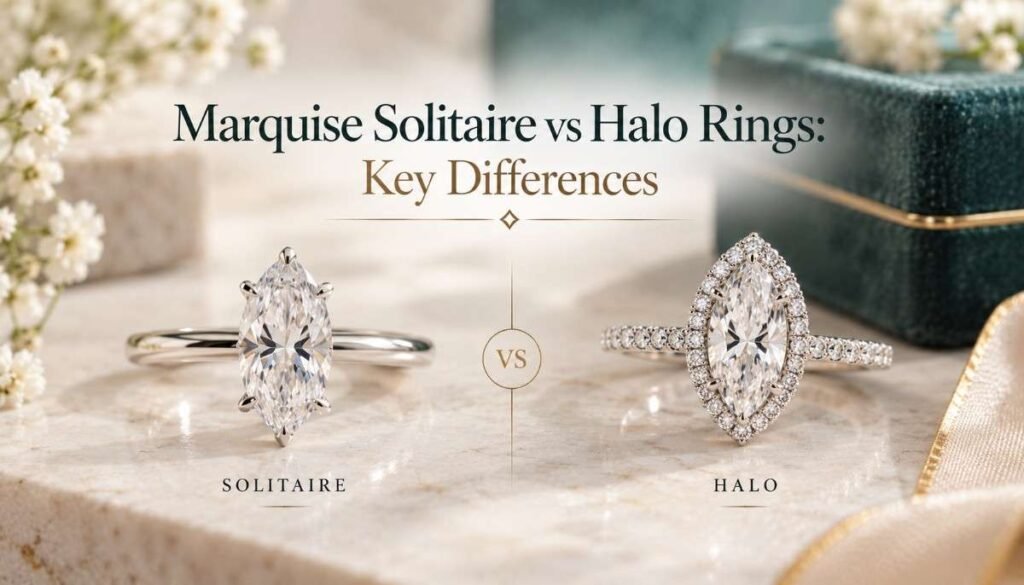

Marquise solitaire vs halo is a more specific decision than the general solitaire-versus-halo debate, since the marquise shape itself changes how each setting actually performs. That pointed, elongated silhouette behaves differently in a clean solitaire than it does surrounded by a ring of accent stones. Here’s a clear breakdown of how these two settings actually compare once a marquise diamond is involved.
Why Marquise Changes the Solitaire vs Halo Comparison
Most solitaire vs halo comparisons focus on round diamonds, where both settings work in fairly predictable ways. Marquise diamonds complicate that comparison, since their pointed tips and elongated shape interact differently with each setting style — affecting brilliance, security, and overall silhouette in ways that don’t apply the same way to rounder shapes.
Marquise Solitaire Rings
A marquise solitaire places the diamond entirely on its own, held by prongs with no accent stones surrounding it. This setting puts full attention on the stone’s elongated shape and natural brilliance, without any additional detail competing for visual space.
Key characteristics:
- Showcases the marquise shape’s dramatic, elongated silhouette without distraction
- Requires precise V-prong engineering at both pointed tips for proper protection
- Offers a clean, minimal look that emphasizes the diamond’s natural cut quality
- Generally easier to maintain, since there are no small accent stones to check regularly
A well-cut marquise diamond in a solitaire setting reads as bold and distinctive, letting the shape itself be the entire design statement.
Marquise Halo Rings
A marquise halo surrounds the centre stone with smaller accent diamonds, adding both perceived size and additional sparkle. Because marquise diamonds already look larger than their carat weight, a halo amplifies that effect further, creating a particularly striking, oversized appearance.
Key characteristics:
- Adds significant perceived size on top of marquise’s already elongating effect
- Helps visually soften the pointed silhouette, since the halo rounds out the overall shape
- Increases sparkle from multiple angles, not just the centre stone alone
- Requires more regular maintenance, since additional small stones need periodic checking
A marquise halo tends to feel more elaborate and detailed than a solitaire, appealing to buyers who want maximum visual impact from the shape.
Marquise Solitaire vs Halo: Key Differences
Perceived Size
A halo setting makes a marquise diamond look noticeably larger than the same stone in a solitaire, compounding the shape’s already strong size illusion. For buyers focused purely on maximizing visual size within a budget, halo has a clear advantage.
Security and Tip Protection
Both settings require V-prong protection at the marquise stone’s tips, but a halo setting can offer slightly more visual reinforcement around those vulnerable points, since the surrounding metalwork and accent stones add structure near the edges. That said, proper V-prong engineering matters equally in both settings — a halo doesn’t replace the need for it.
Silhouette and Style
A solitaire preserves marquise’s sharp, dramatic silhouette in its purest form. A halo softens that silhouette slightly, rounding out the overall shape and creating a less angular, more traditional-feeling appearance despite the elongated centre stone.
Maintenance
Solitaire settings require far less ongoing maintenance, since there’s only the centre stone and its prongs to check periodically. Halo settings need more frequent inspection, given the additional small stones involved.
Budget Allocation
A solitaire allows more of the budget to go directly toward the centre stone’s quality, since there are no accent stones to pay for. A halo can offer a way to increase visual size and brilliance without increasing the centre stone’s carat weight, potentially offering strong value for buyers prioritizing overall visual impact.
Which Should You Choose?
A few questions can help settle the decision:
- Do you want the marquise shape’s silhouette to stand fully on its own, or would added sparkle and size enhance the look you want? Choose solitaire for the former, halo for the latter.
- How much ongoing maintenance are you comfortable with? Solitaire requires less upkeep than halo.
- Is maximizing perceived size a top priority within your budget? Halo settings generally offer a stronger size boost.
- Do you prefer a bold, minimal look or a more detailed, elaborate one? Solitaire leans minimal; halo leans detailed.
Buyers weighing this decision can browse a marquise diamond ring in both solitaire and halo styles to see how each setting actually changes the stone’s appearance in person, since the difference is often more noticeable in hand than in photos.
FAQs: Marquise Solitaire vs Halo Rings
Does a halo setting make a marquise diamond look bigger than a solitaire? Yes. A halo adds visual size on top of marquise’s already elongating shape, creating a noticeably larger appearance than the same stone would have in a solitaire setting.
Do both marquise solitaire and halo settings need V-prong protection? Yes. Regardless of setting style, marquise diamonds require V-prong protection at their pointed tips to prevent chipping, since this is a shape-specific need rather than something a halo can fully replace.
Which setting requires less maintenance, marquise solitaire or halo? Solitaire settings generally require less maintenance, since there’s only the centre stone and its prongs to monitor, while halo settings need more frequent checks due to their additional small accent stones.
The Bottom Line
Marquise solitaire vs halo comes down to how much visual amplification you want layered onto an already dramatic, elongated shape. Solitaire lets the marquise silhouette speak entirely for itself, while halo adds size, sparkle, and a softer overall look. Whichever direction you lean, proper tip protection matters in both, and comparing real pieces before you Buy engagement ring online will show the difference far better than photos alone.