



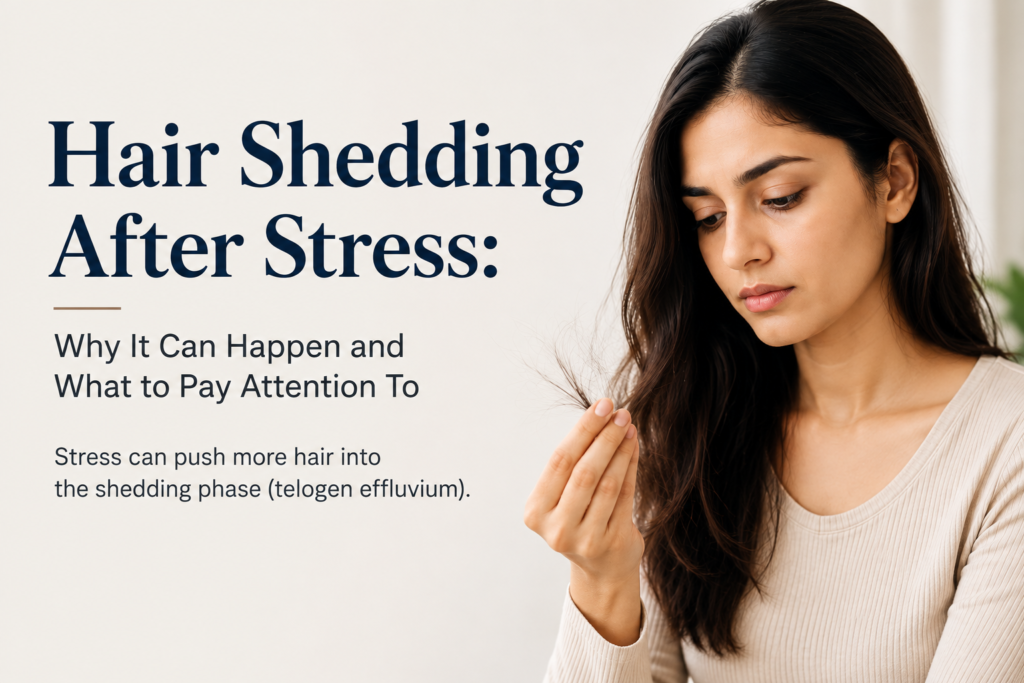

Finding more hair than usual on your pillow, in your brush, or around the shower drain can be worrying.
The first reaction is often to change everything.
A new shampoo. A hair oil. A serum. Maybe a supplement.
But sometimes, the change in your hair may have less to do with the products sitting in your bathroom and more to do with what has been happening in your life.
Stress can affect the body in different ways, and changes in hair shedding may sometimes appear after a physically or emotionally demanding period.
That does not mean every loose strand is caused by stress. Hair shedding can have many possible causes. Still, understanding the difference between normal shedding and a noticeable change can help you decide what to pay attention to.
Some Hair Shedding Is Completely Normal
Hair naturally goes through a cycle.
Individual hairs grow, rest, and eventually shed. That means finding some hair in your brush or shower does not automatically mean you have a hair-loss problem.
What may be more noticeable is a sudden increase in the amount of hair you are shedding.
Perhaps your ponytail feels thinner than before.
Maybe you are seeing more strands on your pillow every morning.
Or you notice that your hair seems to be coming out in larger amounts when washing or brushing it.
A change that continues over time is worth paying attention to.
Stress and Hair Changes May Not Happen at the Same Time
One confusing thing about stress-related hair shedding is that the change may not always appear during the stressful event itself.
You might go through a difficult few months, deal with an illness, experience major changes in your routine, or have a particularly demanding period at work.
Then, weeks or months later, you begin noticing more hair shedding.
This delay can make it difficult to connect the two.
Of course, stress is only one possible factor. Changes in nutrition, hormones, illness, certain medications, and other health issues can also affect the hair.
That is why guessing based on one symptom is not always helpful.
Shedding and Breakage Are Not the Same Thing
Not every strand you find means the same thing.
Hair shedding usually involves hair coming out from the root as part of the natural hair cycle.
Breakage, on the other hand, happens when the hair shaft becomes damaged and snaps.
If you are finding many shorter pieces of hair, frequent heat styling, colouring, chemical treatments, or rough handling may be contributing to breakage.
Tight hairstyles can also put repeated tension on the hair.
Looking closely at what you are seeing can help you understand whether your routine may be causing physical damage or whether you are experiencing increased shedding.
Your Daily Routine May Matter More Than You Think
When life becomes stressful, healthy habits are often the first things to disappear.
Meals become irregular.
Sleep gets shorter.
Exercise stops.
You rely on coffee to get through the day.
None of these things alone will explain every change in your hair, but your overall routine can affect how you feel and function.
Instead of trying to fix everything at once, start with a few basics.
Try to eat regular meals.
Include a variety of nutrient-rich foods.
Get enough rest when possible.
Find a realistic way to manage stress.
The goal is not to create a perfect routine. It is to give your body some consistency during a period when everything else may feel unpredictable.
Be Gentle With Your Hair
When you notice more shedding, it can be tempting to constantly brush, pull, inspect, and experiment with new products.
Sometimes, your hair may benefit from less attention rather than more.
Try to avoid aggressive brushing.
Give your hair a break from frequent high-heat styling when possible.
Avoid very tight hairstyles that pull on the roots.
If your hair feels dry or damaged, focus on gentle care instead of adding multiple treatments at once.
A complicated routine is not always a better routine.
What About Diet and Supplements?
Nutrition plays a role in normal hair growth and overall health.
Your body needs adequate protein and a range of nutrients to function properly.
However, taking every supplement marketed for hair is not necessarily the answer.
If you are considering hair health gummies or another supplement, take the time to read the label carefully.
Look at the ingredients and serving size. If you already take a multivitamin or other supplements, check whether you are doubling up on certain nutrients.
Supplements may be useful in specific situations, but they are not a guaranteed solution for unexplained hair shedding.
A balanced diet and understanding the possible cause of the change are equally important.
Give Changes Time
Hair does not always respond overnight.
That can be frustrating when you want to see improvement quickly.
If you have recently made changes to your routine, give your body time. Constantly switching shampoos, treatments, and supplements can make it harder to know what is actually helping.
Try to keep your routine simple and consistent.
Pay attention to whether the shedding continues, improves, or becomes more noticeable.
Taking occasional photos may also help you track visible changes over time instead of relying only on memory.
When Should You Speak With a Professional?
Occasional shedding is normal, but some changes deserve medical attention.
Consider speaking with a healthcare professional or dermatologist if you notice:
- Sudden or severe hair loss
- Bald patches
- Rapid thinning
- Ongoing shedding that does not improve
- Scalp pain, itching, or other noticeable changes
- Other symptoms occurring alongside hair loss
Hair changes can have many different causes, so identifying the reason is more useful than endlessly trying new products.
Final Thoughts
Stress can affect more than your mood.
After a difficult period, your body may show changes in ways you did not expect, including changes in hair shedding.
But stress is not the only possible explanation.
Instead of panicking over every strand or buying a shelf full of products, take a step back.
Look at what has changed in your routine.
Be gentle with your hair.
Focus on the basics, including sleep, nutrition, and stress management.
And if the shedding feels unusual, continues, or becomes more noticeable, speak with a healthcare professional.
Sometimes, the best way to care for your hair is not to add another product, but to understand what may be changing in the first place.