


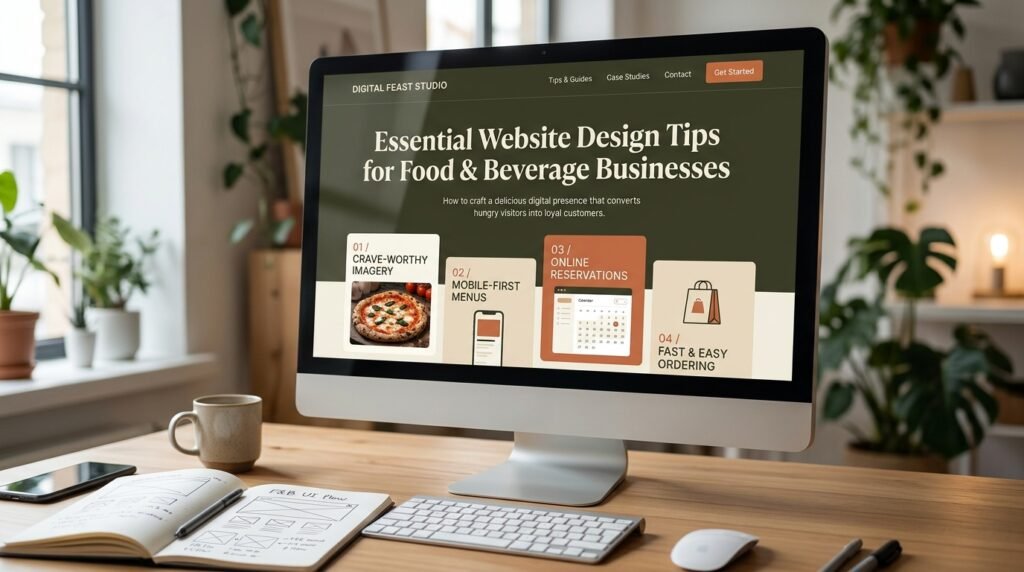

Operating a food or beverage business requires careful consideration of your ingredients, staff, suppliers and customers. To ensure your website isn’t causing additional friction, your site should be easy to navigate. If your customers can’t see your menu, prices, opening times or order options, they will likely go elsewhere. Food & Beverage website design and development can be used to quickly answer common questions, build trust and lead customers to order, book or ask questions.
1. Quick to Understand
Ensure your customers can understand what you sell and where you’re located in a few seconds. Use clear headings, short content and eye-catching visuals of real food items. Your homepage should clearly show:
- What you sell (products/dishes/drinks)
- Where you operate
- Opening times and contact details
- Quick to action buttons such as View Menu, Order Online or book a table
Avoid cluttered banners and generic statements. Good Food and Beverage design should be focussed on making it easy for your customers to move forward.
2. Clear and Up-to-date Menu
Your customers may want to know what ingredients are in your food, how much they’re portioned, how much they cost and any diet specific information. Your menu should have clear sections, short descriptions and any out-of-stock items updated quickly. Ensure your menu has interactive text so it’s easy to read on mobiles and can be understood by search engines. Great restaurant web design will also include clear diet specific labelling that has been approved by your kitchen staff.
3. Easy to Order or Book
Avoid any extra steps as this could lose you sales. Make your order buttons clear, include delivery areas and costs before checkout and make the collection/delivery process easy to understand. Your food and beverage website development should enable customers to:
- Browse your products and choose their favourite items
- See prices, quantities, extras and delivery costs
- Easy payment and collection options
- Receive an order confirmation with approximate delivery/collection times
Your food ordering site should be easy to understand from choosing to confirmation. If you offer bookings, include available times, maximum party size, cancellation information and confirmation details. Try the whole process for yourself.
4. Mobile-Friendly Design
Customers often look at your website whilst they’re travelling or whilst trying to decide where to eat. Don’t frustrate them by having small text, cluttered navigation, slow images and small buttons. Ensure your website is responsive, easy to read, comfortable to use and easy to tap. Whilst designing your café website think about people standing outside your door. They need to know if you’re open, where you’re located and if you offer takeaway. Try looking at your key pages on a mobile.
5. Real Images and Detail
Use real images of your food, drinks, packaging or venue. Optimize your images so they load quickly and include natural alt text. Your food business website should include information on portion sizes, ingredients, claims about where they’re sourced, packaging, storage and collection/delivery. Be clear on any seasonal items. Whilst this may not sound as exciting as making big claims, being honest will avoid disappointing customers and will encourage them to come back.
6. Build Trust
Include your address, telephone number, opening times and easy contact options. Include real reviews (with permission) and respond to any concerns in a professional manner. Only include any information on food safety standards or certifications if you’ve verified this. Great hospitality web design will ensure your website, social media, menus and business information are consistent. Include information on how to ask about allergies, large orders or any issues with service. Being specific will reassure your customers.
7. Local Information
Include a page with your full address, areas you cover, directions, parking/accessibility information and current opening times. If you have multiple locations, include a page for each branch. On your restaurant booking website include information on which branch they’re booking, how long their table will be held for and how they can ask for accessibility support. Ensure your information is consistent across your online listings.
8. Fast, Accessible and SEO-friendly
Optimize your images, remove any unnecessary scripts and use a reliable host. Ensure your website has good contrast, clear forms, descriptive links and keyboard friendly. On your beverage brand website ensure your products are categorized by flavour, ingredients, packaging size, nutritional info, storage and where to buy. Use descriptive page titles, helpful headings, original content and relevant internal links. Using structured data can help search engines understand relevant information but cannot guarantee better results.
9. Track Useful Information
Track useful information such as how many people viewed your menu, how many called you, asked for directions, completed an order, abandoned their basket or booked. Using analytics can show you where people are leaving your site. Any questions they’re asking frequently can be explained by your staff. For example if your menu is a PDF, the order button is hard to find on mobile and delivery costs aren’t shown until checkout. Updating your menu, order button and adding delivery costs will help overcome real issues. Track how well this is working.
10. Helpful Answers
Including a short FAQ section can help reduce calls. Include answers to common questions such as delivery areas, minimum order, payment types, booking for groups, returns, substitutions and allergies. Ensure your answers are specific to your policies and include links to relevant pages. Look at the questions your staff are receiving the most and include answers on your website. This simple section of your food website will save your customers time. Update your answers if any policies change. Ensure you have a clear way to contact them if they have any questions that require a personal touch. Your food & beverage web development should always be customer focussed.
Keep Information Up-to-date
Menus, prices, opening times, seasonal items and delivery policies will all change. Ensure someone regularly checks your information, removes any old promotions, fix any broken links and tests your forms. Food & Beverage web development is an ongoing part of your business. Plan to backup your site, check for security, keep software up-to-date and have an editing process that your team can manage. Old information can make customers question if you’re a reliable business.
Final Thoughts
Your website doesn’t need lots of extra effects or complex features. It should provide answers to real questions, show your products honestly and make it easy for customers to move forward. Start by overcoming the main issue they’re facing. Is your menu confusing? Do you not have any location information? Are there hidden costs? Are your opening times out of date? Get customers to find your menu, try placing an order and/or booking a table. See where they’re struggling. This will give you valuable feedback. When your food & beverage web development is based on real customer needs your website will become a reliable part of your service.
Build a Stronger Online Presence with The Custom Websites
Looking to create a professional website that attracts customers and supports business growth? The Custom Websites helps businesses build visually appealing, user-friendly, and conversion-focused websites tailored to their goals. From responsive layouts and intuitive navigation to customized functionality, the team focuses on creating digital experiences that make it easier for customers to connect with your business. Explore their work, client feedback, and service expertise on The Custom Websites’Clutch profile.