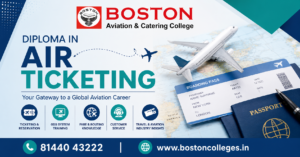
The aviation industry offers several career opportunities for students who are interested in working with airlines, airports, and travel services. Among these opportunities, air ticketing and reservation is an important field that connects passengers with their travel arrangements. Professionals in this area help customers book flight tickets, check schedules, understand fare rules, make itinerary changes, and manage reservation-related enquiries.
To succeed in this profession, candidates need more than basic computer knowledge. Communication, customer service, attention to detail, problem-solving, and technical skills are essential. Proper training can help students understand airline reservation procedures and prepare for entry-level opportunities in the aviation and travel industries.
What Is Air Ticketing and Reservation?
Air ticketing and reservation involves managing flight bookings and providing travel-related assistance to passengers. Professionals working in this field help customers search for suitable flights, check availability, compare fares, reserve seats, and complete ticketing procedures.
They may also assist with cancellations, rescheduling, refunds, baggage information, and special passenger requests. Depending on the organisation, they may work at airline offices, airport ticketing counters, travel agencies, tour operators, or customer support centres. Since these responsibilities directly affect passenger experience, accuracy and professional behaviour are very important.
1. Strong Communication Skills
Communication is one of the most important skills required for an air ticketing professional. Employees regularly interact with passengers who may have different travel needs, questions, and concerns. They must explain flight timings, ticket conditions, baggage allowances, and booking procedures in a clear and polite manner.
Good English communication can be useful when assisting international passengers, while knowledge of regional languages can help professionals communicate with local customers. Students should practise speaking confidently, listening carefully, and providing accurate information. Clear communication helps prevent misunderstandings and creates a positive customer experience.
2. Customer Service and Passenger Handling
Air ticketing professionals must understand how to handle different types of customers. Some passengers may need quick booking assistance, while others may require support with cancellations, delayed flights, or last-minute changes. Remaining patient and professional during busy situations is an important part of the job.
Customer service skills include understanding passenger requirements, responding politely, providing suitable options, and following company procedures. Students can improve these skills through role-play activities, mock booking exercises, and practical training sessions. A customer-friendly approach helps build trust and improves the overall travel experience.
3. Computer and Technical Knowledge
Air ticketing and reservation work involves using computer systems to search for flights, check seat availability, create bookings, and manage passenger information. Candidates should be comfortable using computers, navigating software, entering data, and handling digital records.
Knowledge of airline reservation systems is particularly useful. Training may introduce students to Global Distribution Systems (GDS) and reservation platforms used in the travel industry. Depending on the training provider and employer, students may gain exposure to systems such as Amadeus, Sabre, or Travelport. Familiarity with these tools can help candidates understand common booking procedures.
4. Attention to Detail and Accuracy
Accuracy is essential in air ticketing because even a small mistake can create problems for passengers. Professionals must carefully enter names, travel dates, flight numbers, destinations, and other booking details. They should also verify passenger information before confirming a reservation.
Students should develop the habit of checking every detail before completing a task. Regular practice with sample bookings and itinerary preparation can improve accuracy. Attention to detail is especially important when dealing with international travel, where passport information, visa requirements, and other travel documents may need careful checking.
5. Problem-Solving and Decision-Making
Flight schedules, fares, and passenger requirements can change unexpectedly. Air ticketing professionals may need to assist customers with rescheduling, cancellations, missed connections, or alternative flight options. The ability to understand a problem and identify suitable solutions is therefore valuable.
Good problem-solving involves listening to the passenger, checking available information, understanding airline rules, and explaining possible options. Professionals must avoid making promises they cannot fulfil and should follow the airline’s policies when handling changes or refunds. Staying calm and thinking logically can make challenging situations easier to manage.
6. Knowledge of Airline Rules and Travel Documentation
A successful air ticketing professional should understand basic airline procedures and travel documentation. Important areas include ticket types, fare conditions, baggage allowances, check-in rules, cancellation policies, and refund procedures.
International travel may also involve passports, visas, transit requirements, and destination-specific entry regulations. These requirements can change, so professionals should refer to official airline and government sources rather than relying on outdated information. Developing this knowledge helps employees provide more responsible and accurate travel assistance.
7. Time Management and Multitasking
Air ticketing offices and airport counters can become busy, particularly during holiday seasons and peak travel periods. Employees may need to respond to enquiries, check flight availability, update bookings, and manage customer requests within limited time.
Time management helps professionals prioritise tasks and complete work efficiently without compromising accuracy. Students can practise handling multiple sample enquiries, organising booking information, and completing tasks within a set time. Being organised and focused can improve workplace performance.
Why Is Professional Air Ticketing Training Important?
Professional training gives students an opportunity to understand the basic responsibilities of air ticketing and reservation work. A structured course may cover airline terminology, reservation procedures, ticket issuance, fare calculations, travel documentation, customer service, and computer-based booking activities.
Students searching for the Best Air Ticketing Training Institutes in Tamilnadu should compare course content, practical training facilities, trainer experience, software exposure, and student support. It is also useful to enquire about the exact systems taught, course duration, certification, and career guidance available before joining.
Choosing the Right Aviation Course
Students interested in aviation can explore different programmes based on their educational qualifications and career interests. Some may prefer air ticketing and reservation, while others may be interested in airport ground operations, airline management, cabin crew training, or travel and tourism.
When researching the Best Diploma Aviation Course in Tamilnadu, candidates should look for a programme that combines theoretical knowledge with practical learning. Course topics, eligibility, training methods, faculty support, communication development, and industry exposure should all be considered. Students should also check whether the certificate or diploma is recognised by the relevant awarding body.
Career Opportunities in Air Ticketing and Reservation
After completing suitable training, candidates may explore entry-level opportunities in different areas of the travel and aviation industry. Depending on employer requirements and individual skills, possible roles include:
- Air Ticketing Executive
- Airline Reservation Assistant
- Travel Consultant
- Reservation Executive
- Ticketing Counter Assistant
- Customer Service Executive
- Travel Agency Assistant
- Tour Operations Assistant
Job responsibilities and eligibility requirements vary between employers. Practical knowledge, communication skills, computer proficiency, and customer-handling ability can help candidates prepare for recruitment processes.
How to Compare Training Institutes in India
Students researching the Best Air Ticketing Training Institutes in India should evaluate institutions carefully instead of choosing a course based only on advertisements. Important factors include the syllabus, practical sessions, reservation software training, faculty qualifications, course fees, certification details, and student feedback.
Candidates should also ask whether the institute provides interview preparation, communication training, placement assistance, or career guidance. Placement assistance should not be confused with a guaranteed job. Reviewing the actual services offered can help students make a well-informed decision.
What to Look for in an Aviation College
Students searching for the Best Aviation College in Tamilnadu should consider the overall learning environment and the career support available. A suitable institution should provide a clear course structure, experienced trainers, practical learning opportunities, and guidance that helps students understand industry expectations.
It is beneficial to enquire about classroom facilities, computer-based training, communication development, mock interviews, and the career paths associated with the course. Students should verify the institution’s course details and certification information directly before completing admission.
Conclusion
Building a career in air ticketing and reservation requires a combination of technical knowledge and professional skills. Communication, customer service, computer proficiency, accuracy, problem-solving, and time management are essential for handling passenger bookings effectively. With suitable training and consistent practice, students can develop the confidence needed to explore opportunities in airlines, travel agencies, reservation offices, and other aviation-related organisations.
About Boston Aviation & Catering College
Boston Aviation & Catering College, Madurai, offers career-oriented education in aviation and hospitality-related fields. Students interested in developing their aviation knowledge can enquire about available programmes, including air ticketing and related training options. The institution also provides student guidance and placement support to help learners prepare for career opportunities. Contact the college to learn about course eligibility, duration, fees, and admission details.
Contact:97900 94205
Website: www.bostoncolleges.in